Summary

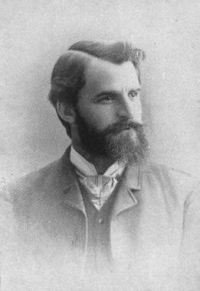
Portrait of Hamlin Garland Hamlin Garland The Trail of the Goldseekers: A Record of Travel in Prose and Verse

In places the threadlike way itself becomes an aqueduct for a rushing overflow of water.
At such times the man on the trail feels the grim power of Nature. She has no pity, no consideration. She sets mud, torrents, rocks, cold, mist, to check and chill him, to devour him. Over him he has no roof, under him no pavement. Never for an instant is he free from the pressure of the elements. Sullen streams lie athwart his road like dragons, and in a land like this, where snowy peaks rise on all sides, rain meant sudden and enormous floods of icy water.
Source: Gutenberg

Portrait of Hamlin Garland Hamlin Garland The Trail of the Goldseekers: A Record of Travel in Prose and Verse

Not so much as a pine branch, not even a willow
Shall swing in the air 'twixt us and our God.
Naked and lone we cross the wide ferry,
Bare to the cold, the dark and the rain.
For here the trail ends.
Here the trail ends. Here by the landing
I wait the last boat, the slow silent one.
We each go alone—no man with another,
Each into the gloom of the swift black flood—
Boys, it is hard, but here we must scatter;
The gray boatman waits, and I—I go first.
All is dark over there where the dim boat is rocking—
But that is no matter! No man need to fear
Source: Gutenberg

Portrait of Hamlin Garland Hamlin Garland The Trail of the Goldseekers: A Record of Travel in Prose and Verse

I had a feeling that I could go on living this way, leading a pack train across the country indefinitely. It seemed somehow as though this way of life, this routine, must continue. I had a deep interest in the four horses, and it was not without a feeling of guilt that I saw them move away on their last trail. At bottom the end of every horse is tragic. Death comes sooner or later, but death here in this country, so cold and bleak and pitiless to all animals, seems somehow closer, more inevitable, more cruel, and flings over every animal the shadow of immediate tragedy.
Source: Gutenberg

Get perspective with Kwize: daily news enlightened by great literature