Summary

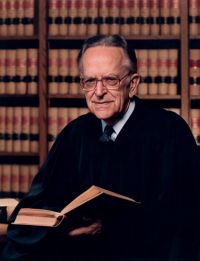
Portrait of Harry Blackmun Harry Blackmun Blatchford v. Native Village of Noatak and Circle Village…

Chief Justice Marshall explained for the Court in Worcester that a federally recognized tribe
"is a distinct community, occupying its own territory, with boundaries accurately described, in which the laws of [the State] can have no force, and which the citizens of [the State] have no right to enter, but with the assent of the [tribes] themselves, or in conformity with the treaties, and with the acts of congress. The whole intercourse between the United States and this nation, is, by our Constitution and laws, vested in the government of the United States."
Source: Wikisource

Portrait of Harry Blackmun Harry Blackmun Blatchford v. Native Village of Noatak and Circle Village…

So it must be, for the judiciary has no power to redraw legislative enactments; where Congress has the authority to regulate a sphere of activity, we simply must do our best to determine whether it has done so in any particular instance. The majority's rule is one method for accomplishing that task. It is premised on the perception that Congress does not casually alter the "balance of power" between the Federal Government and the States.
Source: Wikisource

Portrait of Harry Blackmun Harry Blackmun Blatchford v. Native Village of Noatak and Circle Village…

Thus, in this area, the pertinent "balance of power" is between the Federal Government and the tribes, with the States playing only a subsidiary role. Because spheres of activity otherwise susceptible to state regulation are, "according to the settled principles of our Constitution, . . . committed exclusively to the government of the Union," Worcester v. Georgia, 6 Pet., at 561, where Native American affairs are concerned, the presumptions underlying the clear-statement rule, and thus the rule itself, have no place in interpreting statutes pertaining to the tribes.
Source: Wikisource

Get perspective with Kwize: daily news enlightened by great literature