Summary

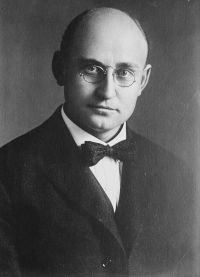
Portrait of Harry L. Hollingworth Harry L. Hollingworth Vocational Psychology: Its Problems and Methods

Just as the value of a commodity depends entirely on what, as a matter of fact, people can be persuaded to pay for it, so the beauty, conceit, neatness, etc., of an individual are mainly constituted by the kind of impression the individual makes on those about him. At least we may be sure that only to the degree that such traits actually manifest themselves and thus determine the reactions of others toward the individual concerned, only to that degree do the traits have vocational significance. Lovableness is just the degree to which people actually have affection for us
Source: Gutenberg

Portrait of Harry L. Hollingworth Harry L. Hollingworth Vocational Psychology: Its Problems and Methods

Each branch of industry, commerce and art, as well as each professional and occupational activity, provides not only for a larger number of workers but for a greater variety as well. There is thus a tendency for the individual at an early point in his career, not only to adapt himself to an environment already provided, but to a certain degree to select that environment for which his abilities and interests seem best to fit him.
Source: Gutenberg

Portrait of Harry L. Hollingworth Harry L. Hollingworth Vocational Psychology: Its Problems and Methods

By average intelligence we do not of course imply any uniform or standardized homogeneous equipment. We mean those varying degrees of intellectual proficiency, educative docility, social coöperativeness and instinctive adequacy which fill the major section of the curve of distribution, that between the feeble-minded and obviously stupid, on the one hand, and on the other the genius, with special and distinguished traits or capacities.
In these occupations the degree of intelligence is by no means the sole determinant of either successful or satisfactory performance.
Source: Gutenberg

Get perspective with Kwize: daily news enlightened by great literature