Summary

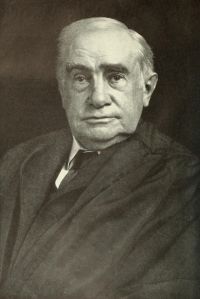
Portrait of Henry Billings Brown Henry Billings Brown Excelsior Wooden Pipe Company v…

While we do not intend to allow the jurisdiction of the Federal courts to be invoked primarily for the determination of the respective rights of parties to a contract concerning patents, yet when the bill is an ordinary one for an infringement and the answer puts in issue the title of the plaintiff to sue, we think the jurisdiction is not ousted by the mere allegation that the license has been revoked, and that the court is at liberty to go on and determine that fact.
Source: Wikisource

Portrait of Henry Billings Brown Henry Billings Brown Excelsior Wooden Pipe Company v…

They thus held a right under the patent. The claim is that this right has been infringed. To determine the suit, therefore, it is necessary to inquire whether there has been an infringement, and that involves a construction of the patents. . . . Such a suit may involve the construction of a contract as well as of a patent, but that will not oust the court of its jurisdiction. If a patent is involved, it carries with it the whole case.' Upon the subject of a licensee suing his own patentee the Chief Justice observed:
'A mere licensee cannot sue strangers who infringe.
Source: Wikisource

Portrait of Henry Billings Brown Henry Billings Brown Excelsior Wooden Pipe Company v…

In such cases redress is obtained through or in the name of the patentee or his assignee. Here, however, the patentee is the infringer, and, as he cannot sue himself, the licensee is powerless, so far as the courts of the United States are concerned, unless he can sue in his own name. A court of equity looks to substance rather than form. When it has jurisdiction of parties it grants the appropriate relief without regard to whether they come as plaintiff or defendant.
Source: Wikisource

Get perspective with Kwize: daily news enlightened by great literature