Summary

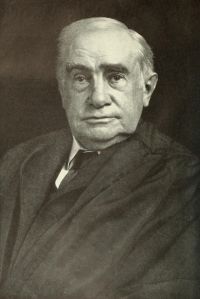
Portrait of Henry Billings Brown Henry Billings Brown Pollock v. Farmers' Loan Trust Company Hyde…

Congress ought never to legislate, in raising the revenues of the government, in fear that important laws like this shall encounter the veto of this court through a change in its opinion, or be crippled in great political crises by its inability to raise a revenue for immediate use. Twice in the history of this country such exigencies have arisen, and twice has congress called upon the patriotism of its citizens to respond to the imposition of an income tax,-once in the throes of civil war, and once in the exigency of a financial panic, scarcely less disastrous.
Source: Wikisource

Portrait of Henry Billings Brown Henry Billings Brown Pollock v. Farmers' Loan Trust Company Hyde…

Even the specter of socialism is conjured up to frighten congress from laying taxes upon the people in proportion to their ability to pay them. It is certainly a strange commentary upon the constitution of the United States and upon a democratic government that congress has no power to lay a tax which is one of the main sources of revenue of nearly every civilized state.
Source: Wikisource

Portrait of Henry Billings Brown Henry Billings Brown Pollock v. Farmers' Loan Trust Company Hyde…

There is no want of power on the part of congress to tax land, but in exercising that power it must impose direct taxes by the rule of apportionment. The power still remains, however, to impose indirect taxes by the rule of uniformity. Being of opinion that a tax upon rents is an indirect tax upon lands, I am driven to the conclusion that the tax in question is valid.
The tax upon the income of municipal bonds falls obviously within the other category,-of an indirect tax upon something which congress has no right to tax at all,-and hence is invalid.
Source: Wikisource

Get perspective with Kwize: daily news enlightened by great literature