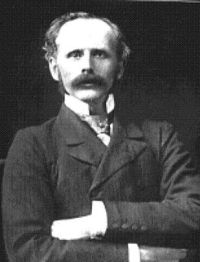
“ I ransack literature for a definition of a correspondence between man and God. Obviously that can only come from one source. And the analogies of Science permit us to apply to it. All knowledge lies in Environment. When I want to know about minerals I go to minerals. When I want to know about flowers I go to flowers. And they tell me. In their own way they speak to me, each in its own way, and each for itself—not the mineral for the flower, which is impossible, nor the flower for the mineral, which is also impossible. So if I want to know about Man, I go to his part of the Environment. ”
Summary
“Eternal Life”, is a work by Henry Drummond. It explores elements such as correspondence, Eternal Life and organism.
Quotes from Eternal Life (Henry Drummond)
“ Into all our thought and work and reading this question pursues us. But the theories are rejected one by one; the great books are returned sadly to their shelves, the years pass, and the problem remains unsolved. The confusion of tongues here is terrible. Every day a new authority announces himself. Poets, philosophers, preachers, try their hand on us in turn. New prophets arise, and beseech us for our soul's sake to give ear to them—at last in an hour of inspiration they have discovered the final truth. Yet the doctrine of yesterday is challenged by a fresh philosophy to-day ”
“ Much more, then, shall we look for the influence of Environment on the spiritual nature of him who has opened correspondence with God. Reaching out his eager and quickened faculties to the spiritual world around him, shall he not become spiritual? In vital contact with Holiness, shall he not become holy? Breathing now an atmosphere of ineffable Purity, shall he miss becoming pure? Walking with God from day to day, shall he fail to be taught of God? ”
“ Of the power of Environment to form or transform organisms, of its ability to develop or suppress function, of its potency in determining growth, and generally of its immense influence in Evolution, there is no need now to speak. But Environment is now acknowledged to be one of the most potent factors in the Evolution of Life. The influence of Environment, too, seems to increase rather than diminish as we approach the higher forms of being. The highest forms are the most mobile; their capacity of change is the greatest; they are, in short, most easily acted on by Environment. ”
“ It is not indifference that keeps some men from God, but ignorance. "Good Master, what must I do to inherit Eternal Life?" is still the deepest question of the age. What is Religion? What am I to believe? What seek with all my heart and soul and mind?—this is the imperious question sent up to consciousness from the depths of being in all earnest hours; sent down again, alas, with many of us, time after time, unanswered. ”
“ Here is the voice of God and the voice of Nature. I cannot be wrong if I listen to them. Sometimes when uncertain of a voice from its very loudness, we catch the missing syllable in the echo. In God and Nature we have Voice and Echo. ”
“ The misgiving which will creep sometimes over the brightest faith has already received its expression and its rebuke: "Who shall separate us from the love of Christ? Shall tribulation, or distress, or persecution, or famine, or nakedness, or peril, or sword?" Shall these "changes in the physical state of the environment" which threaten death to the natural man destroy the spiritual? ”
“ It is for those who accept it to deny the justice of the spiritual analogy. Is religion to them unscientific in its doctrine of Regeneration? Will the evolutionist who admits the regeneration of the frog under the modifying influence of a continued correspondence with a new environment, care to question the possibility of the soul acquiring such a faculty as that of Prayer, the marvellous breathing-function of the new creature, when in contact with the atmosphere of a besetting God? ”
“ The sifting of the correspondences is done by Nature. This is its last and greatest contribution to mankind. Over the mouth of the grave the perfect and the imperfect submit to their final separation. Each goes to its own—earth to earth, ashes to ashes, dust to dust, Spirit to Spirit. ”
“ We are warned, also, not to expect too much. "Thou canst not tell whence it cometh or whither it goeth." This being its quality, when the Spiritual Life is discovered in the laboratory it will possibly be time to give it up altogether. It may say, as Socrates of his soul, "You may bury me—if you can catch me."Science never corroborates a spiritual truth without illuminating it. The threshold of Eternity is a place where many shadows meet. And the light of Science here, where everything is so dark, is welcome a thousand times. Many men would be religious if they knew where to begin ”
“ Correspondence in any case is the gift of Environment. The natural Environment gives men their natural faculties; the spiritual affords them their spiritual faculties. It is natural for the spiritual Environment to supply the spiritual faculties; it would be quite unnatural for the natural Environment to do it. The natural law of Biogenesis forbids it; the moral fact that the finite cannot comprehend the Infinite is against it; the spiritual principle that flesh and blood cannot inherit the kingdom of God renders it absurd. ”
“ Is Evolution to stop with the organic? If it be objected that it has taken ages to perfect the function in the batrachian, the reply is, that it will take ages to perfect the function in the Christian. For every thousand years the natural evolution will allow for the development of its organism, the Higher Biology will grant its product millions. We have indeed spoken of the spiritual correspondence as already perfect—but it is perfect only as the bud is perfect. ”
“ Herbert Spencer—for it is to him we owe it—would be the first to admit the impartiality of his definition; and from the connection in which it occurs in his writings, it is obvious that religion was not even present to his mind. He is analyzing with minute care the relations between Environment and Life. He unfolds the principle according to which Life is high or low, long or short. He shows why organisms live and why they die. And finally he defines a condition of things in which an organism would never die—in which it would enjoy a perpetual and perfect Life. ”
“ Thus a bird in ordinary circumstances has no difficulty in adapting itself to changes of temperature, but if these are varied beyond the point at which its capacity of adjustment begins to fail—for example, during an extreme winter—the organism being unable to meet the condition must perish. The human organism, on the other hand, can respond to this external condition, as well as to countless other vicissitudes under which lower forms would inevitably succumb. Man's adjustments are to the largest known area of Environment, and hence he ought to be able furthest to prolong his Life. ”
“ The amount of correspondence, again, is determined by the greater or less complexity of the organism. Thus a simple organism like the Amoeba is possessed of very few correspondences. It is a mere sac of transparent structureless jelly for which organization has done almost nothing, and hence it can only communicate with the smallest possible area of Environment. An insect, in virtue of its more complex structure, corresponds with a wider area. Nature has endowed it with special faculties for reaching out to the Environment on many sides; it has more life than the Amoeba. ”
“ When we turn, on the other hand, to the doctrine as it came from the lips of Christ, we find ourselves in an entirely different region. He makes no attempt to project the material into the immaterial. The old elements, however refined and subtle as to their matter, are not in themselves to inherit the Kingdom of God. That which is flesh is flesh. Instead of attaching Immortality to the natural organism, He introduces a new and original factor which none of the secular, and few even of the theological theories, seem to take sufficiently into account. ”
“ It comes not from generation, but from regeneration. The relation between the spiritual man and his Environment is, in theological language, a filial relation. With the new Spirit, the filial correspondence, he knows the Father and this is Life Eternal. This is not only the real relation, but the only possible relation: "Neither knoweth any man the Father save the Son, and he to whomsoever the Son will reveal Him." And this on purely natural grounds. It takes the Divine to know the Divine—but in no more mysterious sense than it takes the human to understand the human. ”
“ To be cut off from all Environment is death. To find a new Environment again and cultivate relation with it is to find a new Life. To live is to correspond, and to correspond is to live. So much is true in Science. But it is also true in Religion. And it is of great importance to observe that to Religion also the conception of Life is a correspondence. No truth of Christianity has been more ignorantly or wilfully travestied than the doctrine of Immortality. The popular idea, in spite of a hundred protests, is that Eternal Life is to live forever. ”
“ The difficulty of holding a doctrine is this form, in spite of what has been advanced to the contrary, in spite of the hopes and wishes of mankind, in spite of all the scientific and philosophical attempts to make it tenable, is still profound. No secular theory of personal continuance, as even Butler acknowledged, does not equally demand the eternity of the brute. No secular theory defines the point in the chain of Evolution at which organisms become endowed with Immortality. No secular theory explains the condition of the endowment, nor indicates its goal. ”
“ Now it will speedily appear that a distinct relation exists, and must exist, between complexity and longevity. Death being brought about by the failure of an organism to adjust itself to some change in the Environment, it follows that those organisms which are able to adjust themselves most readily and successfully will live the longest. They will continue time after time to effect the appropriate adjustment, and their power of doing so will be exactly proportionate to their complexity—that is, to the amount of Environment they can control with their correspondences. ”
“ And if we have nothing more to fan hope than the unexplored mystery of the whole region, or the unknown remainders among the potencies of Life, then, as those who have "hope only in this world," we are "of all men the most miserable." ”
“ Death ensues because certain relations in the organism are not adjusted to certain relations in the Environment. There will come a time in each history when the imperfect correspondences of the organism will betray themselves by a failure to compass some necessary adjustment. This is why Death is associated with Imperfection. Death is the necessary result of Imperfection, and the necessary end of it. Imperfect correspondence gives imperfect and uncertain Life. ”
“ In the vocabulary of Science, Eternity is only the fraction of a word. It means mere everlastingness. To Religion, on the other hand, Eternity has little to do with time. To correspond with the God of Science, the Eternal Unknowable, would be everlasting existence; to correspond with "the true God and Jesus Christ," is Eternal Life. The quality of the Eternal Life alone makes the heaven; mere everlastingness might be no boon. Even the brief span of the temporal life is too long for those who spend its years in sorrow. Time itself, let alone Eternity, is all but excruciating to Doubt. ”
“ Is it not possible that these biological truths may carry with them the clue to a still profounder philosophy—even that of Regeneration?Evolutionists tell us that by the influence of environment certain aquatic animals have become adapted to a terrestrial mode of life. Breathing normally by gills, as the result and reward of a continued effort carried on from generation to generation to inspire the air of heaven direct, they have slowly acquired the lung-function. In the young organism, true to the ancestral type, the gill still persists—as in the tadpole of the common frog. ”
“ At whatever point in the zoological scale this correspondence, or set of correspondences, begins, it is certain there is nothing higher. In its stunted infancy merely, when we meet with its rudest beginnings in animal intelligence, it is a thing so wonderful, as to strike every thoughtful and reverent observer with awe. Even among the invertebrates so marvellously are these or kindred powers displayed, that naturalists do not hesitate now, on the ground of intelligence at least, to classify some of the humblest creatures next to man himself. ”
“ Nothing in nature, indeed, is so unlike the rest of nature, so prophetic of what is beyond it, so supernatural. And as manifested in Man who crowns creation with his all-embracing consciousness, there is but one word to describe his knowledge; it is Divine. If then from this point there is to be any further Evolution, this surely must be the correspondence in which it shall take place? This correspondence is great enough to demand development ”
“ He that hath the Son hath Life; conversely, he that hath Life hath the Son. And this indicates at once the quality and the quantity of the correspondence which is to bridge the grave. He that hath Life hath the Son. He possesses the Spirit of the Son. That Spirit is, so to speak, organized within him by the Son. It is the manifestation of the new nature—of which more anon. The fact to note at present is that this is not an organic correspondence, but a spiritual correspondence. ”
“ Emotion, volition, thought itself, are functions of the brain. When the brain is impaired, they are impaired. When the brain is not, they are not. Everything ceases with the dissolution of the material fabric; muscular activity and mental activity perish alike. With the pronounced positive statements on this point from many departments of modern Science we are all familiar. The fatal verdict is recorded by a hundred hands and with scarcely a shadow of qualification. "Unprejudiced philosophy is compelled to reject the idea of an individual immortality and of a personal continuance after death. ”
“ However clumsy, however provisional, however much a mere cloak for ignorance, Science as yet is unable to dispense with the idea of a Principle of Life. We must work with the word till we get a better. Now that which determines the correspondence of the spiritual organism is a Principle of Spiritual Life. ”
“ Before we reach an Eternal Life we must pass beyond that point at which all ordinary correspondences inevitably cease. We must find an organism so high and complex, that at some point in its development it shall have added a correspondence which organic death is powerless to arrest. We must, in short, pass beyond that finite region where the correspondences depend on evanescent and material media, and enter a further region where the Environment corresponded with is itself Eternal. Such an Environment exists. ”
“ But whether the possibilities of physiology or the theories of philosophy do or do not substantially assist us in realizing Immortality, is to Religion, to Religion at least regarded from the present point of view, of inferior moment. The fact of Immortality rests for us on a different basis. Probably, indeed, after all the Christian philosopher never engaged himself in a more superfluous task than in seeking along physiological lines to find room for a soul. ”
“ Not that Eternal Life has nothing to do with everlastingness. That is part of the conception. And it is this aspect of the question that first arrests us in the field of Science. But even Science has more in its definition than longevity. It has a correspondence and an Environment; and although it cannot fill up these terms for Religion, it can indicate at least the nature of the relation, the kind of thing that is meant by Life. Science speaks to us indeed of much more than numbers of years. It defines degrees of Life. ”
“ There are, for example, in the Environment of every animal certain things which are directly or indirectly dangerous to Life. If its equipment of correspondences is not complete enough to enable it to avoid these dangers in all possible circumstances, it must sooner or later succumb. The organism then with the most perfect set of correspondences, that is, the highest and most complex organism, has an obvious advantage over less complex forms. It can adjust itself more perfectly and frequently. ”
“ With a changing Environment even, there must always remain the dread and possibility of a falling out of correspondence. At the best, Life would be uncertain. But with a changeless Environment—such as that possessed by the spiritual organism—the perpetuity of the correspondence, so far as the external relation is concerned, is guaranteed. This quality of permanence in the Environment distinguishes the religious relation from every other. Why should not the musician's life be an Eternal Life? Because, for one thing, the musical world, the Environment with which he corresponds, is not eternal. ”
“ Were the definition complete as it stands, it might, with the permission of the psycho-physiologist, guarantee the Immortality of every living thing. In the dog, for instance, the material framework giving way at death might leave the released canine spirit still free to inhabit the old Environment. And so with every creature which had ever established a conscious relation with surrounding things. Now the difficulty in framing a theory of Eternal Life has been to construct one which will exclude the brute creation, drawing the line rigidly at man, or at least somewhere within the human race. ”
“ In the face of a powerful consensus against even the possibility of a Future Life, to content oneself with saying that Science pretended to no argument in favor of it would be at once impertinent and dishonest. We must therefore devote ourselves for a moment to the question of possibility. ”
“ Not that we need object to the Immortality of the dog, or of the whole inferior creation. Nor that we need refuse a place to any intelligible speculation which would people the earth to-day with the invisible forms of all things that have ever lived. Only we still insist that this is not Eternal Life. And why? Because their Environment is not Eternal. Their correspondence, however firmly established, is established with that which shall pass away. ”
“ And yet—and it is a notorious instance of the fact that men who are opposed to Religion will take their conceptions of its profoundest truths from mere vuglar perversions—this view still represents to many cultivated men the Scriptural doctrine of Eternal Life. From time to time the taunt is thrown at Religion, not unseldom from lips which Science ought to have taught more caution, that the Future Life of Christianity is simply a prolonged existence, an eternal monotony, a blind and indefinite continuance of being. ”
“ And this law, that the degree of Life varies with the degree of correspondence, holds to the minutest detail throughout the entire range of living things. Life becomes fuller and fuller, richer and richer, more and more sensitive and responsive to an ever-widening Environment as we rise in the chain of being. ”
“ To know God, to be linked with God, to be linked with Eternity—if this is not the "eternal existence" of biology, what can more nearly approach it? And yet we are still a great way off—to establish a communication with the Eternal is not to secure Eternal Life. It must be assumed that the communication could be sustained. And to assume this would be to beg the question. So that we have still to prove Eternal Life. ”
“ It has been reserved for modern biology at once to defend and illuminate this central truth of the Christian faith. And hence in the interests of religion, practical and evidential, this second and scientific definition of Eternal Life is to be hailed as an announcement of commanding interest. Why it should not yet have received the recognition of religious thinkers—for already it has lain some years unnoticed—is not difficult to understand. The belief in Science as an aid to faith is not yet ripe enough to warrant men in searching there for witnesses to the highest Christian truths. ”
“ For the first time Science touches Christianity positively on the doctrine of Immortality. It confronts us with an actual definition of an Eternal Life, based on a full and rigidly accurate examination of the necessary conditions. Science does not pretend that it can fulfil these conditions. Its votaries make no claim to possess the Eternal Life. It simply postulates the requisite conditions without concerning itself whether any organism should ever appear, or does now exist, which might fulfil them. ”
“ Communion with God—can it be demonstrated in terms of Science that this is a correspondence which will never break? We do not appeal to Science for such a testimony. We have asked for its conception of an Eternal Life; and we have received for answer that Eternal Life would consist in a correspondence which should never cease, with an Environment which should never pass away. And yet what would Science demand of a perfect correspondence that is not met by this, the knowing of God? There is no other correspondence which could satisfy one at least of the conditions. ”
Common terms
Similar works
"Beautiful Thoughts" (Henry Drummond…The Christian Foundation, Or, Scientific and Religious Journal…Popular Science Monthly (Frances Emily White…The Principles of Biology — Chapter I.6a…1911 Encyclopædia Britannica (Conwy Lloyd Morgan…Natural Law in the Spiritual World…Appearance and Reality — Chapter XXII…Popular Science Monthly (Frank Rattray Lillie…The True and False Theory of Evolution…The American Journal of Sociology…
