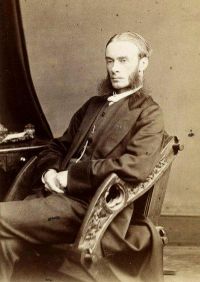
Henry Fanshawe Tozer

Henry Fanshawe Tozer

Summary

Portrait of Henry Fanshawe Tozer Henry Fanshawe Tozer 1911 Encyclopædia Britannica (1911)

The scenery of Euboea is perhaps the most beautiful in Greece, owing to the varied combinations of rock, wood and water; for from the uplands the sea is almost always in view, either the wide island-studded expanse of the Aegean, or the succession of lakes formed by the Euboic Sea, together with mountains of exquisite outline, while the valleys and maritime plains are clothed either with fruit trees or with plane trees of magnificent growth.
Source: Wikisource

Portrait of Henry Fanshawe Tozer Henry Fanshawe Tozer 1911 Encyclopædia Britannica (1911)

The wealth and the semi-Hellenic character of the people—for in race, as in geographical position, the Thessalians held an intermediate place between the non-Hellenic Macedonians and the Greeks of pure blood—caused them to be wanting in patriotism, so that at the time of the Persian wars we find the Aleuadae making common cause with the enemies of Greece. When they were united they were a formidable power, but, like other half-organized communities, they seldom combined for long together, and consequently they influenced but little the fortunes of the Greeks.
Source: Wikisource

Portrait of Henry Fanshawe Tozer Henry Fanshawe Tozer 1911 Encyclopædia Britannica (1911)

At one moment the current runs like a river in one direction, and shortly afterwards with equal velocity in the other. Strabo speaks of it as varying seven times in the day, but it is more accurate to say, with Livy, that it is irregular. A bridge was first constructed here in the twenty-first year of the Peloponnesian War, when Euboea revolted from Athens; and thus the Boeotians, whose work it was, contrived to make that country “an island to every one but themselves.”
Source: Wikisource

Get perspective with Kwize: daily news enlightened by great literature