Summary

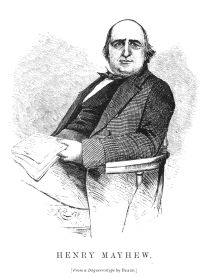
Portrait of Henry Mayhew Henry Mayhew London Labour and the London Poor…

Across Flint-street, Green-street, and other ways, few of them horse thoroughfares, hang, on a fair day, lines of washed clothes to dry. Yellow-looking chemises and petticoats are affixed alongside men’s trowsers and waistcoats; coarse-featured and brazen-looking women, with necks and faces reddened, as if with brick-dust, from exposure to the weather, stand at their doors and beckon to the passers by. Perhaps in no part of the metropolis is there a more marked manifestation of moral obsceneness on the one hand, and physical obsceneness on the other.
Source: Gutenberg

Portrait of Henry Mayhew Henry Mayhew London Labour and the London Poor…

They look squalid and dirty enough; but all of them chatter and several sing over their noisome labour. The atmosphere of the room is close and oppressive; and although no particularly offensive smell is perceptible, there is a choky, mildewy sort of odour—a hot, moist exhalation—arising from the sodden smouldering piles, as the workwomen toss armfuls of rags from one heap to another. This species of work is the lowest and foulest which any phase of the factory system can show.
Source: Gutenberg

Portrait of Henry Mayhew Henry Mayhew London Labour and the London Poor…

With dock labour the poor man’s bread depends upon the very winds; in scavaging and in street life generally it depends upon the rain; and in market-gardening, harvesting, hop-picking, and the like, it depends upon the sunshine. How many thousands in this huge metropolis have to look immediately to the very elements for their bread, it is overwhelming to contemplate; and yet, with all this fitfulness of employment we wonder that an extended knowledge of reading and writing does not produce a decrease of crime!
Source: Gutenberg

Get perspective with Kwize: daily news enlightened by great literature