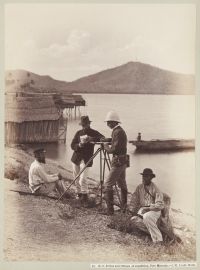
Summary

Portrait of Henry Ogg Forbes Henry Ogg Forbes A Hand-book to the Primates — Cebinae (1894)

When the foremost of the flock reaches the outermost branch of an unusually lofty tree he springs forth into the air without a moment's hesitation and alights on the dome of yielding foliage belonging to the neighbouring tree, maybe fifty feet beneath; all the rest following the example. They grasp, on falling, with hands and tail, right themselves in a moment, and then away they go along branch and bough to the next tree.
Source: Wikisource

Portrait of Henry Ogg Forbes Henry Ogg Forbes A Hand-book to the Primates — Cebinae (1894)

The tendency of Nature here has been, to all appearance, simply to perfect these organs, which adapt the species more and more completely to a purely arboreal life; and no nearer approach has been made towards the more advanced forms of Anthropoid Apes, which are the products of the Old World solely. The tail of the Coaita is endowed with a wonderful degree of flexibility. It is always in motion, coiling and uncoiling like the trunk of an Elephant, and grasping whatever comes within reach....
Source: Wikisource

Portrait of Henry Ogg Forbes Henry Ogg Forbes A Hand-book to the Primates — Cebinae (1894)

Salvin saw a troop of these Monkeys in company with several Spider-Monkeys by the margin of a watercourse in Nicaragua, and remarked that the actions of the latter were bolder and more active than those of the Capuchins, which were slower and more timid.
According to Cuvier, the cry of this animal in captivity is a continuous soft whistle until its wants are satisfied; if it wants nothing this whistle is intermittent, and very soft. When in terror, its cry is a veritable bark, broken by silent intervals.
Source: Wikisource

Get perspective with Kwize: daily news enlightened by great literature