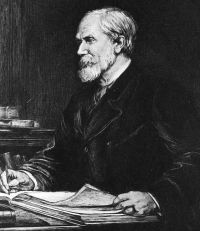
Henry Yule

Henry Yule

Summary

Portrait of Henry Yule Henry Yule,  Hobson-Jobson — E (1903)

“ EUROPE, adj. Commonly used in India for "European," in contradistinction to country (q.v.) as qualifying goods, viz. those imported from Europe. The phrase is probably obsolescent, but still in common use. "Europe shop" is a shop where European goods of sorts are sold in an up-country station. The first quotation applies the word to a man. [A "Europe morning" is lying late in bed, as opposed to the Anglo-Indian's habit of early rising.] ”
Source: Wikisource

Portrait of Henry Yule Henry Yule,  Hobson-Jobson — E (1903)

“ This warrior, speaking from his tomb of the great deeds of his master, and of his own right arm, tells how the king, in the neighbourhood of Ni, hunted 120 elephants for the sake of their tusks; and how he himself (Amenemhib) encountered the biggest of them, which had attacked the sacred person of the king, and cut through its trunk. The elephant chased him into the water, where he saved himself between two rocks; and the king bestowed on him rich rewards. ”
Source: Wikisource

Portrait of Henry Yule Henry Yule,  Hobson-Jobson — E (1903)

“ Nor is it inconsistent with this suggestion that we find also in some of the Northern languages a second series of names designating the elephant—not, as we suppose ulbandus and its kin to be, common vocables descending from a remote age in parallel development—but adoptions from Latin at a much more recent period. Thus, we have in Old and Middle German Elefant and Helfant, with elfenbein and helfenbein for ivory; in Anglo-Saxon, ylpend, elpend, with shortened forms ylp and elp, and ylpenban for ivory; whilst the Scandinavian tongues adopt and retain fil. ”
Source: Wikisource

Get perspective with Kwize: daily news enlightened by great literature