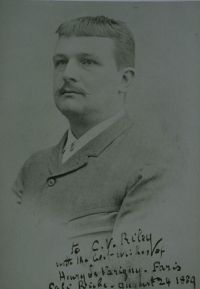
Henry de Varigny

Henry de Varigny

Summary

Portrait of Henry de Varigny Henry de Varigny,  Popular Science Monthly (1881)

“ The brain is like a complex machine, in which, if a screw loosens, or a nut gives way, or a rod bends or breaks, at once all goes wrong. It is not that the screw, nut, or rod in question is the immediate cause of the movements of the machine, but that the failure of these accessories may, for the moment, produce accidents as grave as would be caused by disturbance in much more important parts. ”
Source: Wikisource

Portrait of Henry de Varigny Henry de Varigny,  Popular Science Monthly (1881)

“ Many physiologists claim that these cells are only excitable by the will. For the theory of motor centers they substitute that of psycho-motors. Reserving this discussion for another time and place, we may say that, whether we excite the cells or the fibers that arise from them, the result is the same.
All stimulation, whatever its nature or origin, acts upon a nerve according to its functions. Excite a motor nerve at any point of its course, and you produce movement; excite a sensory nerve, and the subject will feel a sensation which will vary with the nature of the nerve.
”
Source: Wikisource

Portrait of Henry de Varigny Henry de Varigny,  Popular Science Monthly (1881)

“ When the excitant is moved about over the different convolutions, the existence of the motor zone is made manifest by the successive movements of the animal; the sensitive zone is known by signs of sensation, while the indications of an intellectual zone are not thus positive. Observe what passes when we irritate the so-called motor region. We excite a certain point of the convolutions, and a movement is produced. Groping about with our electrodes, we find the effect limited to a small tract where at all the points the same movement is provoked, and that alone. ”
Source: Wikisource

Get perspective with Kwize: daily news enlightened by great literature