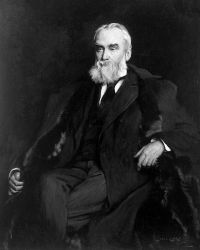
John Hughlings Jackson

John Hughlings Jackson

Summary

Portrait of John Hughlings Jackson John Hughlings Jackson Popular Science Monthly (1884)

Evolution is a passage from the most automatic to the most voluntary. The triple conclusion come to is, that the highest centers, which are the climax of nervous evolution, and which make up the "organ of mind," or physical basis of consciousness, are the least organized, the most complex, and the most voluntary. So much for the positive process by which the nervous system is "put together"—evolution. Now for the negative process, "the taking it to pieces"—dissolution.
Source: Wikisource

Portrait of John Hughlings Jackson John Hughlings Jackson Popular Science Monthly (1884)

In this, as in all other cases of insanity, it is imperative to take equally into account not only the dissolution but the lower level of evolution that remains. The patient's condition is partly negative and partly positive. Negatively, he ceases to know that he is in hospital, and ceases to recognize persons about him. In other words, he is lost to his surroundings, or, in equivalent terms, he is defectively conscious. We must not say that he does not know where he is because he is defectively conscious; his not knowing where he is, is itself defect of consciousness.
Source: Wikisource

Portrait of John Hughlings Jackson John Hughlings Jackson Popular Science Monthly (1884)

The doctrine of evolution daily gains new adherents. It is not simply synonymous with Darwinism. Herbert Spencer applies it to all orders of phenomena. His application of it to the nervous system is most important for medical men. I have long thought that we shall be very much helped in our investigations of diseases of the nervous system by considering them as reversals of evolution—that is, as dissolutions. Dissolution is a term I take from Spencer as meaning the reverse of the process of evolution.
Source: Wikisource

Get perspective with Kwize: daily news enlightened by great literature