Hemiplegia

Definition and stakes

James Law,  Text book of veterinary medicine… (1902)

“ The cranial nerves proceed to muscles on the same side as their origin, while filaments going to the trunk through the spinal cord, cross in the pyramids (motor) , or spinal cord (sensory) . In crossed hemiplegia, hemianæsthesia is common with both forms of paralysis on one side.
Spinal Hemiplegia has the face and head sound (except sometimes the iris) , and half the body paralyzed on the side opposite to that on which the spinal lesion (clot) exists. If anæsthesia exists it is on the side opposite to the lesion and posterior to it—the sensory filaments crossing just before leaving the cord.
”
Source: Gutenberg

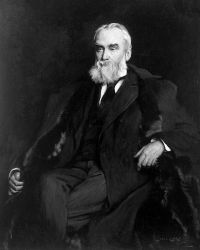
Portrait of John Hughlings Jackson John Hughlings Jackson,  Popular Science Monthly (1884)

“ Going a stage higher we come to hemiplegia, owing to destruction of part of a plexus in the mid-region of the brain. Choosing the commonest variety of hemiplegia, we say that there is loss of more or fewer of the most voluntary movements of one side of the body; we find that the arm, the more voluntary limb, suffers the more and longer; we find, too, that the most voluntary part of the face suffers more than the rest of the face. Here we must speak particularly of the lower level of evolution remaining ”
Source: Wikisource

A system of practical medicine… (1886)

“ If, however, with or without a complete hemiplegia, a limited lesion, as in the pons, affects the nucleus of a nerve, the peripheral distribution of that nerve is cut off from its nutritive centre, and it undergoes the usual changes which lead to the reaction of degeneration, so that, in some unusual forms of paralysis, the two kinds of reaction, normal and degenerative, may be present in different sets of muscles. ”
Source: Gutenberg

Get perspective with Kwize: daily news enlightened by great literature