“ The uterus or womb is the house of the embryo almost from the moment of conception to the moment of birth. Within the thick warm sheltered walls of the uterus the child grows, develops, eats and breathes, until all its organs and functions have reached such a stage of perfection that it can live by itself and for itself. And this may be said to be the sole function of the uterus, or at least its sole useful function. ”
Uterus
Definition and stakes
The uterus, a hormone-sensitive reproductive organ in female mammals, functions as the site of embryonic and fetal development. Authors such as William J. Robinson highlight its role as a "house of the embryo," while Anna M. Galbraith describes its anatomical structure and the effects of its displacement. E.
Heinrich Kisch focuses on its physiological changes during pregnancy, and Lydia Estes Pinkham emphasizes its relationship with neighboring organs. These viewpoints together demonstrate the uterus’s dual nature as a biological container and a flexible organ that adjusts to reproductive processes, pregnancy, and disease, underscoring its significance in both medical and biological discussions.
Quotes about “uterus”
Lena K. Sadler, The Mother and Her Child
“ While this division of the united sex cells is progressing, a wonderful change is also taking place in the inside lining of the uterus. Instead of the usual thin lining, it has greatly thickened and has become highly sensitized, and as the ovum enters the uterus from the fallopian tube, this sensitized lining catches it and holds it in its folds—actually covers it with itself—holding the precious mass much as the cocoon, you have so often seen fastened to the side of a plant or leaf, holds its treasure of life. ”
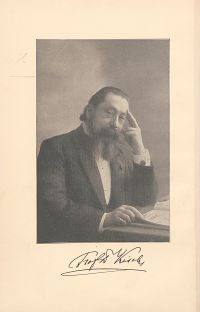 E. Heinrich Kisch,
The sexual life of woman in its physiological…
E. Heinrich Kisch,
The sexual life of woman in its physiological…
“ When conception occurs, still more extensive changes ensue, the fertilized ovum becoming imbedded in the uterine mucous membrane, and the pregnant uterus, in shape and structure and in the respective relations of the body and neck of the organ, in the increasing distension of its veins and the increasing size of its nerves, becoming adapted to the important functions it has now to fulfil. When these have been fulfilled, and, parturition having taken place, the uterus is empty once more, the organ again adapts itself to altered circumstances by the process of involution. ”
Related terms
Authors who wrote about “uterus”
E. Heinrich KischCharles B. Penrose Carolyn Conant Van BlarcomWilliam HarveyS. P. Sackett
 Charles KnowltonFrederick HollickAnna M. Galbraith
 Joel ShewJohn Burns
 Alice B. StockhamLydia Estes PinkhamWilliam J. Robinson
 George M. Gould
 Elizabeth Nihell
 James ParsonsJ. S. M. FonblanqueAmanda K. BeckRobert B. ArmitageAlbert Moll