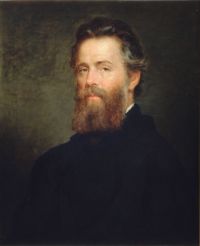
Herman Melville

Herman Melville

Summary

Portrait of Herman Melville Herman Melville Bartleby, the Scrivener (Part 1… (1853)

At about eleven o'clock though, in the morning, I noticed that Ginger Nut would advance toward the opening in Bartleby's screen, as if silently beckoned thither by a gesture invisible to me where I sat. The boy would then leave the office jingling a few pence, and reappear with a handful of ginger-nuts which he delivered in the hermitage, receiving two of the cakes for his trouble.
He lives, then, on ginger-nuts, thought I; never eats a dinner, properly speaking; he must be a vegetarian then; but no; he never eats even vegetables, he eats nothing but ginger-nuts.
Source: Wikisource

Portrait of Herman Melville Herman Melville Bartleby, the Scrivener (Part 1… (1853)

For both I and Bartleby were sons of Adam. I remembered the bright silks and sparkling faces I had seen that day, in gala trim, swan-like sailing down the Mississippi of Broadway; and I contrasted them with the pallid copyist, and thought to myself, Ah, happiness courts the light, so we deem the world is gay; but misery hides aloof so we deem that misery there is none. These sad fancyings—chimeras, doubtless, of a sick and silly brain—led on to other and more special thoughts, concerning the eccentricities of Bartleby.
Source: Wikisource

Portrait of Herman Melville Herman Melville Bartleby, the Scrivener (Part 1… (1853)

Without loudly bidding Bartleby depart—as an inferior genius might have done—I assumed the ground that depart he must; and upon that assumption built all I had to say. The more I thought over my procedure, the more I was charmed with it. Nevertheless, next morning, upon awakening, I had my doubts,—I had somehow slept off the flumes of vanity. One of the coolest and wisest hours a man has, is just after he awakes in the morning.
Source: Wikisource

Get perspective with Kwize: daily news enlightened by great literature