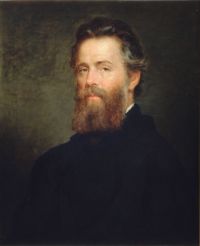
Herman Melville

Herman Melville

Summary

Portrait of Herman Melville Herman Melville Israel Potter — Chapters 26-27 (1855)

Encouraged by the exodus of the lost tribes of soldiers, Israel returned to chair-bottoming. And it was in frequenting Covent-Garden market, at early morning, for the purchase of his flags, that he experienced one of the strange alleviations hinted of above. That chatting with the ruddy, aproned, hucksterwomen, on whose moist cheeks yet trickled the dew of the dawn on the meadows; that being surrounded by bales of hay, as the raker by cocks and ricks in the field; those glimpses of garden produce, the blood-beets, with the damp earth still tufting the roots
Source: Wikisource

Portrait of Herman Melville Herman Melville Israel Potter — Chapters 26-27 (1855)

Yet not a few of these petitioners had never been outside of the London smoke; a sort of crafty aristocracy in their way, who, without having endangered their own persons much if anything, reaped no insignificant share both of the glory and profit of the bloody battles they claimed; while some of the genuine working heroes, too brave to beg, too cut-up to work, and too poor to live, laid down quietly in corners and died.
Source: Wikisource

Portrait of Herman Melville Herman Melville Israel Potter — Chapters 26-27 (1855)

An itinerant, he paraded the streets with the cry of “Old chairs to mend!” furnishing a curious illustration of the contradictions of human life; that he who did little but trudge, should be giving cosy seats to all the rest of the world. Meantime, according to another well-known Malthusian enigma in human affairs, his family increased. In all, eleven children were born to him in certain sixpenny garrets in Moorfields. One after the other, ten were buried.
When chair-bottoming would fail, resort was had to match-making.
Source: Wikisource

Get perspective with Kwize: daily news enlightened by great literature