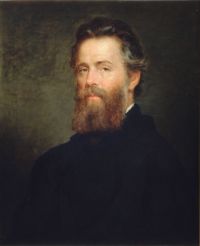
Herman Melville

Herman Melville

Summary

Portrait of Herman Melville Herman Melville,  Typee — Chapter 15

“ The leaves of the bread-fruit are of great size, and their edges are cut and scolloped as fantastically as those of a lady's lace collar. As they annually tend towards decay, they almost rival in brilliant variety of their gradually changing hues the fleeting shades of the expiring dolphin. The autumnal tints of our American forests, glorious as they are, sink into nothing in comparison with this tree.
The leaf, in one particular stage, when nearly all the prismatic colours are blended on its surface, is often converted by the natives into a superb and striking head-dress.
”
Source: Wikisource

Portrait of Herman Melville Herman Melville,  Typee — Chapter 15

“ At a certain season of the year, when the fruit of the hundred groves of the valley has reached its maturity, and hangs in golden spheres from every branch, the islanders assemble in harvest groups, and garner in the abundance which surrounds them.
The trees are stripped of their nodding burdens, which, easily freed from the rind and core, are gathered together in capacious wooden vessels, where the pulpy fruit is soon worked by a stone pestle, vigorously applied, into a blended mass of a doughy consistency, called by the natives 'Tutao'.
”
Source: Wikisource

Portrait of Herman Melville Herman Melville,  Typee — Chapter 15

“ How true it is, that the rarity of any particular article enhances its value amazingly. In some part of the valley—I know not where, but probably in the neighbourhood of the sea—the girls were sometimes in the habit of procuring small quantities of salt, a thimble-full or so being the result of the united labours of a party of five or six employed for the greater part of the day. ”
Source: Wikisource

Get perspective with Kwize: daily news enlightened by great literature