Summary

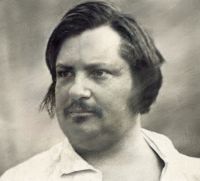
Portrait of Honoré de Balzac Honoré de Balzac Eugénie Grandet — Chapter VI

Innocence alone can dare to be so bold. Once enlightened, virtue makes her calculations as well as vice. Eugenie, who had not trembled beside her cousin, could scarcely stand upon her legs when she regained her chamber. Her ignorant life had suddenly come to an end; she reasoned, she rebuked herself with many reproaches.
"What will he think of me? He will think that I love him!"
That was what she most wished him to think. An honest love has its own prescience, and knows that love begets love. What an event for this poor solitary girl thus to have entered the chamber of a young man!
Source: Wikisource

Portrait of Honoré de Balzac Honoré de Balzac Eugénie Grandet — Chapter VI

That staircase, so often traversed, which echoed to the slightest noise, now lost its decaying aspect in the eyes of Eugenie. It grew luminous; it had a voice and spoke to her; it was young like herself,—young like the love it was now serving. Her mother, her kind, indulgent mother, lent herself to the caprices of the child's love, and after the room was put in order, both went to sit with the unhappy youth and keep him company. Does not Christian charity make consolation a duty?
Source: Wikisource

Portrait of Honoré de Balzac Honoré de Balzac Eugénie Grandet — Chapter VI

Grandet, who was a poor sleeper, employed half his nights in the preliminary calculations which gave such astonishing accuracy to his views and observations and schemes, and secured to them the unfailing success at sight of which his townsmen stood amazed. All human power is a compound of time and patience. Powerful beings will and wait. The life of a miser is the constant exercise of human power put to the service of self. It rests on two sentiments only,—self-love and self-interest
Source: Wikisource

Get perspective with Kwize: daily news enlightened by great literature