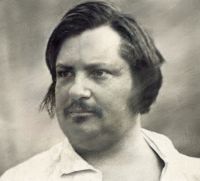
Honoré de Balzac

Honoré de Balzac

Summary

Portrait of Honoré de Balzac Honoré de Balzac Melmoth Reconciled

He felt the awful melancholy of omnipotence, a melancholy which Satan and God relieve by the exercise of infinite power in mysterious ways known to them alone. Castanier had not, like his Master, the inextinguishable energy of hate and malice; he felt that he was a devil, but a devil whose time was not yet come, while Satan is a devil through all eternity, and being damned beyond redemption, delights to stir up the world, like a dung heap, with his triple fork and to thwart therein the designs of God.
Source: Gutenberg

Portrait of Honoré de Balzac Honoré de Balzac Melmoth Reconciled

The Nero unknown to history who dreams of setting Paris on fire for his private entertainment, like an exhibition of a burning house on the boards of a theatre, does not suspect that if he had the power, Paris would become for him as little interesting as an ant-heap by the roadside to a hurrying passer-by. The circle of the sciences was for Castanier something like a logogriph for a man who does not know the key to it. Kings and Governments were despicable in his eyes. His great debauch had been in some sort a deplorable farewell to his life as a man.
Source: Gutenberg

Portrait of Honoré de Balzac Honoré de Balzac Melmoth Reconciled

He will commit a crime if so he may be great and noble in the eyes of some woman or of his special public; such is the nature of the man. Such a lover is like a gambler who would be dishonored in his own eyes if he did not repay the sum he borrowed from a waiter in a gaming-house; but will shrink from no crime, will leave his wife and children without a penny, and rob and murder, if so he may come to the gaming-table with a full purse, and his honor remain untarnished among the frequenters of that fatal abode. So it was with Castanier.
Source: Gutenberg

Get perspective with Kwize: daily news enlightened by great literature