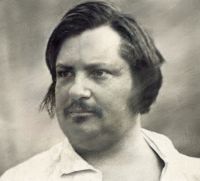
Honoré de Balzac

Honoré de Balzac

Summary

Portrait of Honoré de Balzac Honoré de Balzac The Ball at Sceaux (1830)

But those who loved Emilie could see through all her banter a tinge of melancholy. It was clear that Maximilien Longueville still reigned over that inexorable heart. Sometimes she would be as gentle as she had been during the brief summer that had seen the birth of her love; sometimes, again, she was unendurable. Every one made excuses for her inequality of temper, which had its source in sufferings at once secret and known to all. The Comte de Kergarouet had some influence over her, thanks to his increased prodigality, a kind of consolation which rarely fails of its effect on a Parisian girl.
Source: Wikisource

Portrait of Honoré de Balzac Honoré de Balzac The Ball at Sceaux

The early autumn had come to the handsome pair, in the midst of country festivities and pleasures; they had abandoned themselves softly to the tide of the sweetest sentiment in life, strengthening it by a thousand little incidents which any one can imagine; for love is in some respects always the same. They studied each other through it all, as much as lovers can.
“Well, well; a flirtation never turned so quickly into a love match,” said the old uncle, who kept an eye on the two young people as a naturalist watches an insect in the microscope.
Source: Gutenberg

Portrait of Honoré de Balzac Honoré de Balzac The Ball at Sceaux

This touch of natural magic lent a certain solemnity to the moment. The young man’s free and eager action, and, above all, the throbbing of his surging heart, whose hurried beating spoke to Emilie’s arm, stirred her to an emotion that was all the more disturbing because it was produced by the simplest and most innocent circumstances. The restraint under which the young girls of the upper class live gives incredible force to any explosion of feeling, and to meet an impassioned lover is one of the greatest dangers they can encounter.
Source: Gutenberg

Get perspective with Kwize: daily news enlightened by great literature