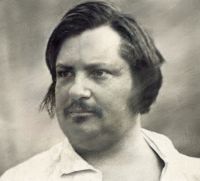
Honoré de Balzac

Honoré de Balzac

Summary

Portrait of Honoré de Balzac Honoré de Balzac The Works of Honoré de Balzac (1901)

When they both die of poison, and Gertrude becomes repentant, we feel that the denouement is not satisfactory. The jealousy of the woman and the hatred of the man have not blended properly.
But there can be no doubt at all that if Balzac had lived, he might have turned out a successful playwright. When he began his career as a dramatic writer he was like a musician taking up an unfamiliar instrument, an organist who was trying the violin, or a painter working in an unknown medium. His last written play was his best.
Source: Wikisource

Portrait of Honoré de Balzac Honoré de Balzac The Works of Honoré de Balzac (1901)

For in a painting, the artist at his own will arranges the light and shade and groups, and combines according to his own fancy the figures and objects which he finds in nature. He represents not what is, but what might be, an actual scene. He aims at a specific effect. To this effect everything is sacrificed, for his work is a synthesis, not a mere analysis. Balzac does not aim at an effect, above and independent of his analysis.
Source: Wikisource

Portrait of Honoré de Balzac Honoré de Balzac The Works of Honoré de Balzac (1901)

The greatest fame of Balzac will rest in the future, as in the past, upon his novels and short stories. These comprise the bulk of his work and his most noteworthy effort—an effort so pronounced as to hide all side-excursions. For this reason his chief side-excursion—into the realms of drama—has been almost entirely overlooked. Indeed, many of his readers are unaware that he ever wrote plays, while others have passed them by with the idea that they were slight, devoid of interest, and to be classified with the Works of Youth.
Source: Wikisource

Get perspective with Kwize: daily news enlightened by great literature