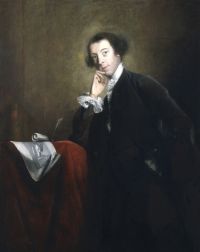
Horace Walpole

Horace Walpole

Summary

Portrait of Horace Walpole Horace Walpole Hieroglyphic Tales

All the fury that authority loves to console itself with for being under restraint, all the asperity of a bigot, all the acrimony of party, and all the fictitious rage that prudery adopts when the sensual enjoyments of others are concerned, burst out on the helpless Azora, who was unable to divine how she was concerned in the fatal letter. She was made to endure all the calumnies that the abbess would have been glad to have hurled at the head of madame Grimaldi, if her own character and the rank of that offender would have allowed it.
Source: Gutenberg

Portrait of Horace Walpole Horace Walpole Hieroglyphic Tales

The disciples of Loyola—Of whom? said the emperor, yawning—Ignatius Loyola, the founder of the Jesuits, replied Gronovia, was—A writer of Roman history, I suppose, interrupted the emperor: what the devil were the Romans to you, that you trouble your head so much about them? The empire of Rome, and the church of Rome, are two distinct things, said the princess; and yet, as one may say, the one depends upon the other, as the new testament does on the old. One destroyed the other, and yet pretends a right to its inheritance.
Source: Gutenberg

Portrait of Horace Walpole Horace Walpole Hieroglyphic Tales

The Cyprian queen, not content with the numerous oblations of Orondates on her altars, was not satisfied while his heart remained unengaged. Across the canal, overagainst the palace of Grimaldi, stood a convent of Carmelite nuns, the abbess of which had a young African slave of the most exquisite beauty, called Azora, a year younger than Orondates. Jet and japan were tawny and without lustre, when compared to the hue of Azora. Afric never produced a female so perfect as Azora; as Europe could boast but of one Orondates.
Source: Gutenberg

Get perspective with Kwize: daily news enlightened by great literature