Summary

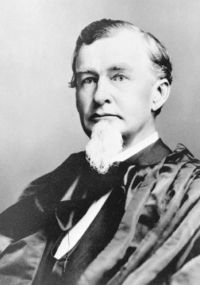
Portrait of Howell Edmunds Jackson Howell Edmunds Jackson Mobile Company v. Tennessee — Opinion of the Court

It has never been denied, nor is it now, that the supreme court of the United States has an appellate power to revise the judgment of the supreme court of a state, whenever such a court shall adjudge that not to be a contract which has been alleged, in the forms of legal proceedings, by a litigant, to be one within the meaning of that clause of the constitution of the United States which inhibits the states from passing laws impairing the obligation of contracts.
Source: Wikisource

Portrait of Howell Edmunds Jackson Howell Edmunds Jackson Mobile Company v. Tennessee — Opinion of the Court

No one species of property from which a tax may be collected shall be taxed higher than any other species of property of equal value,'-the supreme court of Tennessee gave no effect to that clause of the charter as an exemption, either fixed, conditional, or contingent, but proceeded upon the theory that the property of the railroad company became absolutely liable to taxation on and after April 22, 1886, at the expiration of the 25 years from the completion of the road, without regard to the state of the company's earnings, or its capacity to pay dividends in any amount.
Source: Wikisource

Portrait of Howell Edmunds Jackson Howell Edmunds Jackson Mobile Company v. Tennessee — Opinion of the Court

The only matter involving construction or interpretation is the meaning to be attached to the term 'dividend.' It admits of no question that the word 'dividend,' mentioned therein, has reference to dividends on the capital stock of the company held and owned by its shareholders. The term 'dividend,' in its technical as well as in its ordinary acceptation, means that portion of its profits which the corporation, by its directory, sets apart for ratable division among its shareholders.
Source: Wikisource

Get perspective with Kwize: daily news enlightened by great literature