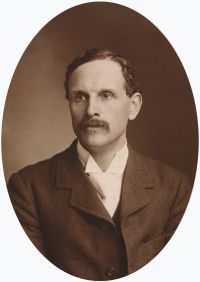
Hugh Longbourne Callendar

Hugh Longbourne Callendar

Summary

Portrait of Hugh Longbourne Callendar Hugh Longbourne Callendar 1911 Encyclopædia Britannica, Volume 6… (1911)

In measuring conduction of heat in fluids, it is possible to some extent to eliminate the effects of molar convection or mixing, but it would not be possible to distinguish between diffusion, or internal radiation, and conduction. Some writers have supposed that the ultimate atoms are conductors, and that heat is transferred through them when they are in contact. This, however, is merely transferring the properties of matter in bulk to its molecules. It is much more probable that heat is really the kinetic energy of motion of the molecules, and is passed on from one to another by collisions.
Source: Wikisource

Portrait of Hugh Longbourne Callendar Hugh Longbourne Callendar 1911 Encyclopædia Britannica, Volume 6… (1911)

Forbes’s Bar Method.—Observation of the steady distribution of temperature along a bar heated at one end was very early employed by Fourier, Despretz and others for the comparison of conductivities. It is the most convenient method, in the case of good conductors, on account of the great facilities which it permits for the measurement of the temperature gradient at different points; but it has the disadvantage that the results depend almost entirely on a knowledge of the external heat loss or emissivity, or, in comparative experiments, on the assumption that it is the same in different cases.
Source: Wikisource

Portrait of Hugh Longbourne Callendar Hugh Longbourne Callendar 1911 Encyclopædia Britannica, Volume 6… (1911)

This he called the external conductivity, but the term emissivity is more convenient. Taking Newton’s law of cooling that the rate of loss of heat is simply proportional to the excess of temperature, the emissivity would be independent of the temperature. This is generally assumed to be the case in mathematical problems, but the assumption is admissible only in rough work, or if the temperature difference is small. The emissivity really depends on every variety of condition, such as the size, shape and position of the surface, as well as on its nature
Source: Wikisource

Get perspective with Kwize: daily news enlightened by great literature