Summary

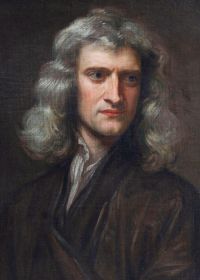
Portrait of Isaac Newton Isaac Newton Philosophiae Naturalis Principia Mathematica…

In bodies, we see only their figures and colours, we hear only the sounds, we touch only their outward surfaces, we smell only the smells, and taste the savours; but their inward substances are not to be known, either by our senses, or by any reflex act of our minds; much less then have we any idea of the substance of God. We know him only by his most wise and excellent contrivances of things, and final causes; we admire him for his perfections; but we reverence and adore him on account of his dominion.
Source: Wikisource

Portrait of Isaac Newton Isaac Newton Philosophiae Naturalis Principia Mathematica…

It is the dominion of a spiritual being which constitutes a God; a true, supreme, or imaginary dominion makes a true, supreme, or imaginary God. And from his true dominion it follows that the true God is a Living, Intelligent, and Powerful Being; and, from his other perfections, that he is Supreme or most Perfect. He is Eternal and Infinite, Omnipotent and Omniscient; that is, his duration reaches from Eternity to Eternity; his presence from Infinity to Infinity; he governs all things, and knows all things that are or can be done. He is not Eternity and Infinity, but Eternal and Infinite
Source: Wikisource

Portrait of Isaac Newton Isaac Newton Philosophiae Naturalis Principia Mathematica…

Every man, so far as he is a thing that has perception, is one and the same man during his whole life, in all and each of his organs of sense. God is the same God, always and everywhere. He is omnipresent, not virtually only, but also substantially; for virtue cannot subsist without substance. In him [2] are all things contained and moved; yet neither affects the other: God suffers nothing from the motion of bodies; bodies find no resistance from the omnipresence of God.
Source: Wikisource

Get perspective with Kwize: daily news enlightened by great literature