Summary

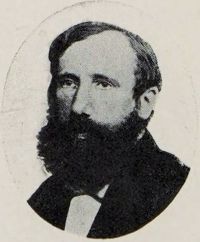
Portrait of Isaac Todhunter Isaac Todhunter The Elements of Euclid for the Use of Schools and Colleges (1872)

That a proposition may be false and yet furnish consequences which are true, can be seen from a simple example. Suppose a theorem were proposed for investigation in the following words; one angle of a triangle is to another as the side opposite to the first angle is to the side opposite to the other. If this be assumed to be true we can immediately deduce Euclid's result in I. 19; but from Euclid's result in I. 19 we cannot retrace our steps and establish the proposed theorem, and in fact the proposed theorem is false.
Source: Wikisource

Portrait of Isaac Todhunter Isaac Todhunter The Elements of Euclid for the Use of Schools and Colleges (1872)

There are three famous problems which are now admitted to be beyond the power of Geometry; namely, to find a straight line equal in length to the circumference of a given circle, to trisect any given angle, and to find two mean proportionals between two given straight lines. The grounds on which the geometrical solution of these problems is admitted to be impossible cannot be explained without a knowledge of the higher parts of mathematics
Source: Wikisource

Portrait of Isaac Todhunter Isaac Todhunter The Elements of Euclid for the Use of Schools and Colleges (1872)

The definition of a square assumes more than is necessary. For if a four-sided figure have all its sides equal and one angle a right angle, it may be shewn that all its angles are right angles; or if a four-sided figure have all its angles equal, it may be shewn that they are all right angles.
Postulates. The postulates state what processes we assume that we can effect, namely, that we can draw a straight line between two given points, that we can produce a straight line to any length, and that we can describe a circle from a given centre with a given distance as radius.
Source: Wikisource

Get perspective with Kwize: daily news enlightened by great literature