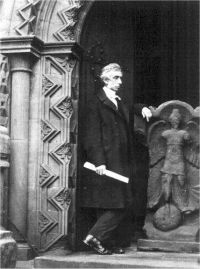
J. Collingwood Bruce

J. Collingwood Bruce

Summary

Portrait of J. Collingwood Bruce J. Collingwood Bruce The Roman Wall

Whilst, as previously observed, the Wall shoots over the highest and steepest summits, the road pursues its tortuous course from one platform of the rock to another, so as to bring the traveller from mile-castle to mile-castle by the easiest possible gradients. Often has it been my lot to notice how naturally, towards the close of a fatiguing day’s march, the less zealous of our exploring party, more anxious to select an easy track than to keep close companionship with the Wall, have, most unconsciously, pursued the route of the Roman way.
Source: Gutenberg

Portrait of J. Collingwood Bruce J. Collingwood Bruce The Roman Wall

PROSPECTIVE FATE OF BRITAIN. In that island, where, in Roman days, the painted savage shared the forest with the beast of prey—a lady sits upon her throne of state, wielding a sceptre more potent than Julius or Hadrian ever grasped! Her empire is threefold that of Rome in the hour of its prime. But power is not her brightest diadem. The holiness of the domestic circle irradiates her. Literature, and all the arts of peace, flourish under her sway.
Source: Gutenberg

Portrait of J. Collingwood Bruce J. Collingwood Bruce The Roman Wall

Severus was drawn into Britain by the revolt of almost all the confederate tribes; and, after many great and dangerous battles, he thought fit to divide that part of the island which he had recovered from the other unconquered nations, not with a wall, as some imagine, but with a rampart. For a wall is made of stones, but a rampart, with which camps are fortified to repel the assaults of enemies, is made of sods, cut out of the earth, and raised above the ground all around like a wall, having in front of it the ditch whence the sods were taken, and strong stakes of wood fixed upon its top.
Source: Gutenberg

Get perspective with Kwize: daily news enlightened by great literature