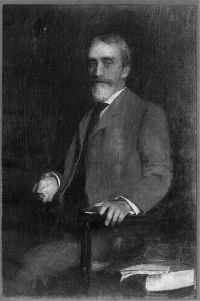
James Bradley Thayer

James Bradley Thayer

Summary

Portrait of James Bradley Thayer James Bradley Thayer Legal Tender (1887)

It is clear that the power to regulate commerce between the States carries with it, not impliedly, but necessarily and directly, a full power of regulating the essential element of commerce, namely, the currency of the country, the money, which constitutes the life and soul of commerce. We live in an age when paper money is an essential element in all trade between the States
Source: Wikisource

Portrait of James Bradley Thayer James Bradley Thayer Legal Tender (1887)

But, if the Constitution knows only gold and silver as a legal tender, does it follow that the Constitution cannot tolerate the voluntary circulation of bank notes, convertible into gold and silver at the will of the holder, as part of the actual money of the country? Is a man not only to be entitled to demand gold and silver for every debt, but is he, or should he be, obliged to demand it in all cases?
Source: Wikisource

Portrait of James Bradley Thayer James Bradley Thayer Legal Tender (1887)

If the question were about legislation reducing the duty on wool, and it should be argued in a judicial opinion that the law is contrary to the spirit of the Constitution, because it is the aim of that instrument “to form a more perfect union,” while this law is necessarily unsatisfactory to the people of a certain section of the Union, and tends to alienate them from it,— that kind of reasoning would be instantly felt to be out of place. It seems, at best, to belong to legislative, rather than judicial discussion.
Source: Wikisource

Get perspective with Kwize: daily news enlightened by great literature