Summary

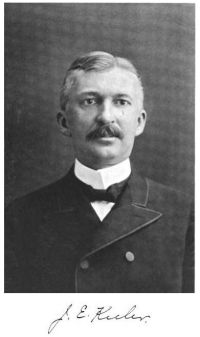
Portrait of James Edward Keeler James Edward Keeler Photographs of Nebulæ and Clusters…

When a telescope is used for photographing objects near the pole, with long exposures, the polar axis must be quite accurately adjusted, for otherwise the centers of motion of the stars and of the telescope will not agree, and the star images will be distorted. It is true that with a double-slide plate-holder, like the one used with the Crossley reflector, one star—namely, the guiding star—is forced to remain in a fixed position with respect to the plate; but the differential motion of the other stars causes them to describe short arcs, or trails, around this star as a center.
Source: Gutenberg

Portrait of James Edward Keeler James Edward Keeler Photographs of Nebulæ and Clusters…

Why the focus of the telescope should change during a long exposure is not quite clear. The change is much too great to be accounted for by expansion and contraction of the rods forming the tube, following changes of temperature, while a simple geometrical construction shows that a drooping of the upper end of the tube, increasing the distance of the plate from the (unreflected) axis of the mirror, can not displace the focus in a direction normal to the plate, if it is assumed that the field is flat.
Source: Gutenberg

Portrait of James Edward Keeler James Edward Keeler Photographs of Nebulæ and Clusters…

This will be done the next time the mirror is resilvered.
All that the observer can do when a jump occurs is to bring back the image as quickly as possible to the intersection of the cross-wires. If all the stars on the plate are faint, no effect will be produced on the photograph; but stars of the eighth magnitude or brighter will leave short trails. The nebula, if there is one on the plate, will, of course, be unaffected.
Before beginning an exposure the focus is adjusted by means of a high-power positive eyepiece.
Source: Gutenberg

Get perspective with Kwize: daily news enlightened by great literature