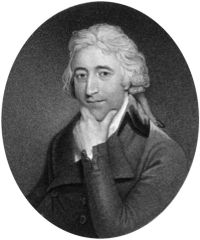
James Edward Smith

James Edward Smith

Summary

Portrait of James Edward Smith James Edward Smith A specimen of the botany of New Holland (1793)

Whole tribes of plants, which at first sight seem familiar to his acquaintance, as occupying links in Nature's chain, on which he has been accustomed to depend, prove, on a nearer examination, total strangers, with other configurations, other œconomy, and other qualities; not only all the species that present themselves are new, but most of the genera, and even natural orders.
Source: Wikisource

Portrait of James Edward Smith James Edward Smith A specimen of the botany of New Holland (1793)

Leaves somewhat hairy.
AMID all the beauty and variety which the vegetable productions of New Holland display in such profusion, there has not yet been discovered a proportionable degree of usefulness to mankind, at least with respect to food. This is our first and most natural enquiry in a scene of such novelty; but it is an enquiry natural to all the lower orders of sensible beings, as well as to man. It may perhaps mortify his pride to think how much more quickly and certainly inferior animals judge upon such a subject. Their powers however reach no farther.
Source: Wikisource

Portrait of James Edward Smith James Edward Smith A specimen of the botany of New Holland (1793)

The seeds brought to this country have never vegetated.
The shrub is 8 or 10 feet in height, with several wandlike simple round branches, covered with a smooth brown bark, and clothed with numerous large alternate leaves, without stipulæ. These leaves are from 4 to 6 or 8 inches, long, obovate, not broad, blunt, but tipped with a small point, smooth and veiny, paler and even glaucous beneath, more or less serrated in their upper part with sharp unequal teeth, entire, and very much attenuated at the base, running down into a short rusty-coloured footstalk.
Source: Wikisource

Get perspective with Kwize: daily news enlightened by great literature