Summary

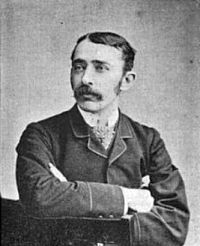
Portrait of John Ambrose Fleming John Ambrose Fleming 1911 Encyclopædia Britannica, Volume 18… (1911)

The current to be measured is passed through the coils of the electromagnet, then enters the mercury disk at the centre, flows through it radially in all directions, and emerges at the periphery. The mass of mercury is thus set in motion owing to the tendency of a conductor conveying an electric current to move transversely across lines of magnetic force; it becomes in fact the armature of a simple form of dynamo, and rotates with a speed which increases with the strength of the current.
Source: Wikisource

Portrait of John Ambrose Fleming John Ambrose Fleming 1911 Encyclopædia Britannica, Volume 18… (1911)

In those meters which are compounded—that is, have a shunt coil wound on the field magnets to compensate for the friction of the train—it is important to notice whether the meter will operate or continue operating when there is no current in the series coil, since a meter which “runs on the shunt” runs up a debt against the consumer for which it gives no corresponding advantage.
Source: Wikisource

Portrait of John Ambrose Fleming John Ambrose Fleming 1911 Encyclopædia Britannica, Volume 18… (1911)

The principle, of the meter is to make the breaking and driving action so strong that the friction of the train becomes immaterial in comparison. This meter is an ampere-hour meter and applicable only to continuous current circuits. Another form of motor meter which is much used is that of Elihu Thomson. It takes the form of a small dynamo having an armature and field magnets without any iron core. The armature carries on its shaft a commutator made of silver slips, and the current is fed into the armature by means of brushes of silver wire.
Source: Wikisource

Get perspective with Kwize: daily news enlightened by great literature