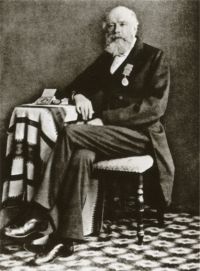
John Henry Parker

John Henry Parker

Summary

Portrait of John Henry Parker John Henry Parker The archæology of Rome, Part VII (1876)

The amphitheatre at Nîmes, in Aquitaine, still has a wooden floor with trap-doors in it; the present floor is not ancient, but no doubt replaces an old one; there is no staircase, and the only access to the passages below is by a step-ladder, and the arrangement of the substructures is quite different from that in Rome, or at Capua, or Puteoli. There are large masses of stone at intervals to support the floor, and wide passages between them. On two of these massive piers are inscriptions, with the name of the architect, the same inscription repeated twice, in characters of the third century.
Source: Gutenberg

Portrait of John Henry Parker John Henry Parker The archæology of Rome, Part VII (1876)

These two canals, parallel to each other, to be supplied with water by the aqueducts, and used for the naumachia or naval fights, are among the most curious discoveries brought to light in the recent explorations. They shew how completely the whole of the great public exhibitions of the ancient Romans were theatrical displays, with all the usual tricks of a theatre, just the same as in a Christmas pantomime.
This shews also that stagna do not necessarily mean ponds; any reservoir of water is a stagnum, whether supplied by a natural spring or by an aqueduct.
Source: Gutenberg

Portrait of John Henry Parker John Henry Parker The archæology of Rome, Part VII (1876)

Vast as this amazing edifice still is, the whole of the outer wall with the arcades and corridors, on the south and west sides, have been destroyed, having been used as a stone quarry for building some of the largest palaces in Rome, but on the north and east sides it is tolerably perfect. A correct idea of the whole can only be formed by mounting to the top, and surveying the whole extent from thence. The finest view of the exterior is from the Thermæ of Titus, or the windows or the garden of the monastery of S. Pietro in Vincoli, on the hill opposite the north front.
Source: Gutenberg

Get perspective with Kwize: daily news enlightened by great literature