Summary

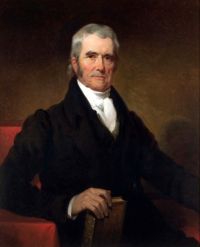
Portrait of John Marshall John Marshall Blake v. Doherty — Opinion of the Court

So strongly am I impressed with this opinion, that I see no reason why a grant may not have the effect of a standing warrant of survey, as long as the land, purporting to have been surveyed, shall remain unoccupied. It is doing no injury to the individual right; and the State having received a compensation, and pledged itself for the conveyance of a certain quantity of land, sustains no injury, where the survey is reasonable, and bearing a subsequent conformity to the grant and survey under which the claim is asserted.
Source: Wikisource

Portrait of John Marshall John Marshall Blake v. Doherty — Opinion of the Court

If it is a plan made by authority, in conformity with any act of the legislature, it may be submitted, with other evidence, to the consideration of a jury, to avail, as much as it may, in ascertaining boundary. But the Court has also permitted what is denominated a demarcation, which we understand to be a private survey made by direction of a party interested under the grant, and assented to by the defendants, to be given in evidence.
Source: Wikisource

Portrait of John Marshall John Marshall Blake v. Doherty — Opinion of the Court

This liberal provision would have been totally unnecessary if the grantee might have remedied every uncertainty in his patent by his own act. If under his patent he might survey any vacant land he chose, the privilege of obtaining a new patent would be a very useless one.
It is obvious, that the legislature did not suspect the existence of this power to make new boundaries where none before had been made, or where none could be found.
Source: Wikisource

Get perspective with Kwize: daily news enlightened by great literature