Summary

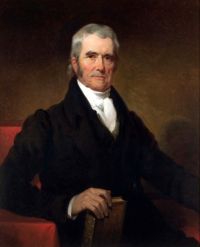
Portrait of John Marshall John Marshall Chinoweth v. Lessee of Haskell…

But where are we to look for these two small chesnut oaks in a wilderness in which one man takes up fifty thousand acres of land, and another one hundred thousand? Or how are we to distinguish them from other chesnut oaks? The guide and the only guide given us by the survey, or by the grant, is the course and distance. We are to find them at the end of a line of four thousand six hundred poles, to be run south nine degrees west from the established corner at D. We are furnished with no other guide which may conduct us to them.
Source: Wikisource

Portrait of John Marshall John Marshall Chinoweth v. Lessee of Haskell…

The defendants in the district court having withdrawn their cause from the jury by a demurrer to evidence, or having submitted to a verdict for the plaintiffs subject to that demurrer, cannot hope for a judgment in their favour, if, by any fair construction of the evidence, the verdict can be sustained. If this cannot be done, the judgment rendered for the defendants in error must be reversed.
It is an obvious principle that a grant must describe the land to be conveyed, and that the subject granted must be identified by the description given of it in the instrument itself.
Source: Wikisource

Portrait of John Marshall John Marshall Chinoweth v. Lessee of Haskell…

If it be surveyed according to the courses and distances called for, it will entirely exclude that land. The plaintiffs, however, claim to survey it in such manner as to comprehend the tenements in possession of the defendants.
A survey was made, and the diagram of the surveyor, with his report, exhibits the respective claims of the parties. The diagram A. B. C. D. E. F. A. represents the land claimed by the plaintiffs. A. B. C. D. G. H. A. represents the land, which, as the defendants contend, the grant to the plaintiffs ought to cover.
Source: Wikisource

Get perspective with Kwize: daily news enlightened by great literature