Summary

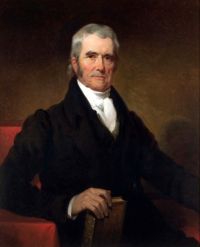
Portrait of John Marshall John Marshall Conolly v. Taylor — Opinion of the Court

The 11th section of the judiciary act of 1789, gives jurisdiction to the circuit courts 'of all suits of a civil nature at common law or in equity, where the matter in dispute exceeds, exclusive of costs, the sum or value of five hundred dollars, and the United States are plaintiffs or petitioners, or an alien is a party, or the suit is between the citizen of a state where the suit is brought, and a citizen of another state.' Thus the act presents three distinct classes of cases, where the Court takes jurisdiction from the character of the parties
Source: Wikisource

Portrait of John Marshall John Marshall Conolly v. Taylor — Opinion of the Court

The substantial parties plaintiffs, those for whose benefit the decree is sought, are aliens; and the court has original jurisdiction between them and all the defendants. But they prevented the exercise of this jurisdiction, by uniting with themselves a person between whom and one of the defendants the court cannot take jurisdiction. Strike out his name as a complainant, and the impediment is removed to the exercise of that original jurisdiction which the court possessed, between the alien plaintiffs and all the citizen defendants.
Source: Wikisource

Get perspective with Kwize: daily news enlightened by great literature