Summary

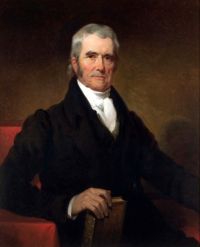
Portrait of John Marshall John Marshall Ex parte Crane v. Crane — Opinion of the Court

There can be no doubt that a party is entitled to his exception, if he sees fit to take one, upon every question of law stated to the jury. I have not the bill of exceptions now before me. I am not aware of any question of law arising upon the charge, which is not embraced within some one of the points specifically submitted to the court, and upon which the court gave an opinion: all which are contained in the bill of exceptions. If this is not the case, and it is pointed out, it ought to be added to the bill of exceptions, and I will again look at it.
Source: Wikisource

Portrait of John Marshall John Marshall Ex parte Crane v. Crane — Opinion of the Court

That a mandamus to sign a bill of exceptions is 'warranted by the principles and usages of law,' is, we think, satisfactorily proved by the fact that it is given in England by statute; for the writ given by the statute of Westminster the second, is so in fact, and is so termed in the books. The judicial act speaks of usages of law generally, not merely of common law. In England it is awarded by the chancellor; but in the United States it is conferred expressly on this court, which exercises both common law and chancery powers; is invested with appellate power
Source: Wikisource

Get perspective with Kwize: daily news enlightened by great literature