Summary

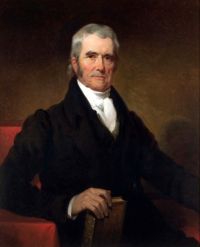
Portrait of John Marshall John Marshall Lessor of Fisher v. Cockerell…

The counsel for the plaintiff in error has referred to former decisions of this court, laying down the general principle, that the title under a treaty or law of the United States need not be specially pleaded; that it need not be stated on the record that a construction has been put on a treaty or law which this court may deem erroneous; or that an unconstitutional statute of a state has been held to be constitutional. It is sufficient, if the record shows that such misconstruction must have taken place or the decision could not have been made.
Source: Wikisource

Portrait of John Marshall John Marshall Lessor of Fisher v. Cockerell…

When the record of the Union circuit court was transferred to the court of appeals, the course of that court requires that the appellant, or the plaintiff in error, should assign the errors on which he means to rely. This assignment contains the first intimation that the title was derived from Virginia, and that the plaintiff in error relied on the compact between the two states.
Source: Wikisource

Portrait of John Marshall John Marshall Lessor of Fisher v. Cockerell…

We say with confidence that this court has never taken jurisdiction, unless the case as stated in the record was brought within the provisions of the twenty-fifth section of the judicial act. There are some cases in which the jurisdiction of the court has been negatived, that are entitled to notice. Owings vs. Norwood's Lessee, 5 Cr. 344, was an ejectment brought in the general court of Maryland for a tract of land lying in Baltimore county. The defendant set up as a bar to the action, an outstanding title in a British subject, which, he contended, was protected by the treaty of peace.
Source: Wikisource

Get perspective with Kwize: daily news enlightened by great literature