Summary

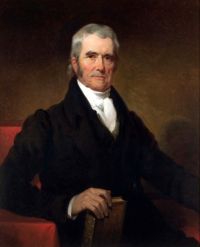
Portrait of John Marshall John Marshall Peirsoll v. Elliott — Opinion of the Court

That under such circumstances a court of equity can have no jurisdiction over the cause.
The court is well satisfied that this would be a proper case for a decree according to the prayer of the bill, if the defectiveness of the conveyance was not apparent on its face, but was to be proved by extrinsic testimony. The doubt respecting the propriety of the interference of a court of equity, is produced by the facts that the deed is void upon its face
Source: Wikisource

Portrait of John Marshall John Marshall Peirsoll v. Elliott — Opinion of the Court

The defendants, in their answer, insist upon their title both at law and in equity, and on being left free to assert that title, if they shall choose so to do: a general dismission of the bill with costs, the court assigning no reason for that dismission, may be considered as a decree affirming the principles asserted in the answer; as leaving the defendants at full liberty to assert their title in another ejectment, and as giving some countenance to that title.
Source: Wikisource

Portrait of John Marshall John Marshall Peirsoll v. Elliott — Opinion of the Court

These are proper objects of equity jurisdiction. If they had been accomplished when the decree was pronounced, the bill might have been dismissed, but not so far as is disclosed by the record, with costs. The defendants were not, we think, entitled to costs. We are therefore of opinion that the decree of the circuit court ought to be so modified as to express the principles on which the bill of the plaintiffs is to be dismissed, and ought to be reversed as respects costs.
Source: Wikisource

Get perspective with Kwize: daily news enlightened by great literature