Summary

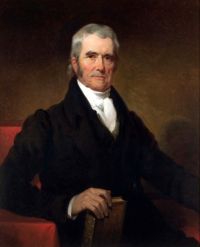
Portrait of John Marshall John Marshall Providence v. Billings — Opinion of the Court

How can a law which, beyond all human control, arms the legislature with the legal right of doing what the constitution prohibits their doing, be constitutional? Nay, worse: which puts them in the actual possession of a power, the very existence of which is a violation of the contract. How can the legislature legislate themselves into the possession of a power, not only not granted, but expressly withheld by the people?
Source: Wikisource

Portrait of John Marshall John Marshall Providence v. Billings — Opinion of the Court

How can it be of vital importance to government to possess the power to tax the money of one man, without at the same time taxing the money of others? How can the existence of government depend on its power to destroy its contracts? There is nothing, then, growing out of the peculiar importance of the power in question, which will rebut any presumption of an exemption from its exercise.
Source: Wikisource

Portrait of John Marshall John Marshall Providence v. Billings — Opinion of the Court

If, in a contract between individuals, no illegal power can be implied, in a contract with a sovereign can any unconstitutional power be implied? By becoming a party to a contract, a state imposes upon itself additional obligations and additional duties. To suppose that these duties and these obligations do not qualify its rights, is tantamount to denying that they are obligations and duties. To impose upon an individual, or a sovereign, an obligation, without an equivalent limitation of its legal and moral power, is as impossible, as to produce an effect without a cause.
Source: Wikisource

Get perspective with Kwize: daily news enlightened by great literature