Summary

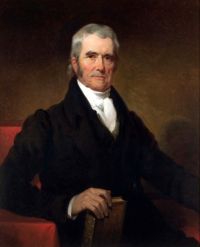
Portrait of John Marshall John Marshall United States v. Robertson — Opinion of the Court

But without going out of the bond, this stipulation must be considered as being made on the part of the United States. For what purpose, we repeat, was it made? If the individual members of the board were bound by the agreement, why require a bond from the same persons as sureties for themselves? They could be sued upon the original agreement as well as upon the bond. Why this complex proceeding? Upon the hypothesis of individual obligation under the agreement, it is inexplicable. Upon the hypothesis that the original agreement was a mere corporate act, the whole transaction is accounted for.
Source: Wikisource

Portrait of John Marshall John Marshall United States v. Robertson — Opinion of the Court

Three judges are of opinion that by the nature of the contract and by the operation of the act of Maryland upon it, an original right existed to discharge the debt in the notes of the bank; which original right remains in full force against the United States, who come in as assignees in law, not in fact; and who must therefore stand in the place of the bank.
Source: Wikisource

Portrait of John Marshall John Marshall United States v. Robertson — Opinion of the Court

For the performance of this engagement, the directors agree to bind themselves individually in a sum equal to the amount of the debt; but this bond of individuals is not to be understood as a contract for the absolute payment of the said sum of money, but as a guarantee that the president and directors, and their successors, will fulfil their agreement to preserve the entire estate of the corporation, until the United States are satisfied with the principal, and to give a preference to the United States over any other creditor of the bank.
Source: Wikisource

Get perspective with Kwize: daily news enlightened by great literature