Summary

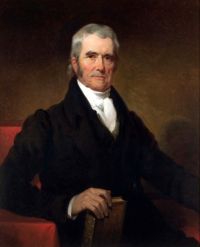
Portrait of John Marshall John Marshall United States v. Wilson (32 U.S. 150…

If the question on which the judges doubted was, whether such a pardon ought to restrain the court from pronouncing judgment in the case before them, which was expressly excluded from it; the first inquiry is, whether the robbery charged in the one indictment is the same with that charged in the other? This is neither expressly affirmed nor denied. If the convictions be for different robberies, no question of law can arise on the effect which the pardon of the one may have on the proceedings for the others.
Source: Wikisource

Portrait of John Marshall John Marshall United States v. Wilson (32 U.S. 150…

But if a man avails himself thereof, as by course of law he may, a pardon may either be pleaded on arraignment, or in arrest of judgment, or, in the present stage of proceedings, in bar of execution.' The reason why a court must ex officio take notice of pardon by act of parliament, is that it is considered as a public law; having the same effect on the case, as if the general law punishing the offence had been repealed or annulled.
Source: Wikisource

Portrait of John Marshall John Marshall United States v. Wilson (32 U.S. 150…

Suppose, the condition is exile, and he thinks the sentence a lighter punishment? Suppose, he thinks it his interest to undergo the punishment, in order to make his peace with the public for an offence committed in sudden temptation? A prisoner might be placed in circumstances, when he would feel it to be his interest to suffer imprisonment or pay a fine, as the evidence of his contrition. Might he not, under such circumstances, refuse to accept a general and unconditional pardon?
It is hardly necessary to speculate on the case of a man refusing to accept a pardon in a capital case.
Source: Wikisource

Get perspective with Kwize: daily news enlightened by great literature