Summary

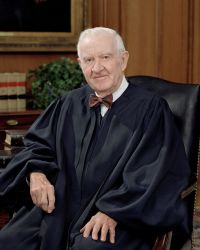
Portrait of John Paul Stevens John Paul Stevens Austin v. Michigan Chamber of Commerce…

The premise of our system is that there is no such thing as too much speech-that the people are not foolish but intelligent, and will separate the wheat from the chaff. As conceded in Lincoln's aphorism about fooling "all of the people some of the time," that premise will not invariably accord with reality; but it will assuredly do so much more frequently than the premise the Court today embraces: that a healthy democratic system can survive the legislative power to prescribe how much political speech is too much, who may speak, and who may not.
Source: Wikisource

Portrait of John Paul Stevens John Paul Stevens Austin v. Michigan Chamber of Commerce…

In permitting Michigan to make private corporations the first object of this Orwellian announcement, the Court today endorses the principle that too much speech is an evil that the democratic majority can proscribe. I dissent because that principle is contrary to our case law and incompatible with the absolutely central truth of the First Amendment: that government cannot be trusted to assure, through censorship, the "fairness" of political debate.
Source: Wikisource

Portrait of John Paul Stevens John Paul Stevens Austin v. Michigan Chamber of Commerce…

But media corporations make money by making political commentary, including endorsements. For them, unlike any other corporations, the whole world of politics and ideology is fair game. Yet the Court tells us that it is reasonable to exclude media corporations, rather than target them specially.
Members of the institutional press, despite the Court's approval of their illogical exemption from the Michigan law, will find little reason for comfort in today's decision. The theory of New Corruption it espouses is a dagger at their throats.
Source: Wikisource

Get perspective with Kwize: daily news enlightened by great literature