Summary

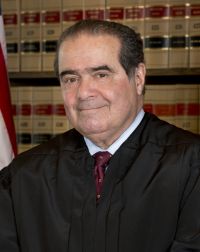
Portrait of Antonin Scalia Antonin Scalia Hill v. Colorado — Dissent Scalia (2000)

Today, of course, Justice Stevens gives us an opinion restricting not only handbilling but even one-on-one conversation of a particular content. There comes a point—and the Court's opinion today passes it—at which the regulation of action intimately and unavoidably connected with traditional speech is a regulation of speech itself. The strictures of the First Amendment cannot be avoided by regulating the act of moving one's lips; and they cannot be avoided by regulating the act of extending one's arm to deliver a handbill, or peacefully approaching in order to speak.
Source: Wikisource

Portrait of Antonin Scalia Antonin Scalia Hill v. Colorado — Dissent Scalia (2000)

The only way the narrow-tailoring objection can be eliminated is to posit a state-created, First-Amendment-trumping "right to be let alone" as broad and undefined as Brandeis's Olmstead dictum, which may well (why not, if the Court wishes it?) embrace a right not to be spoken to without permission from a distance closer than eight feet. Nothing stands in the way of that solution to the narrow-tailoring problem—except, of course, its utter absurdity, which is no obstacle in abortion cases.
Source: Wikisource

Portrait of Antonin Scalia Antonin Scalia Hill v. Colorado — Dissent Scalia (2000)

Having deprived abortion opponents of the political right to persuade the electorate that abortion should be restricted by law, the Court today continues and expands its assault upon their individual right to persuade women contemplating abortion that what they are doing is wrong. Because, like the rest of our abortion jurisprudence, today's decision is in stark contradiction of the constitutional principles we apply in all other contexts, I dissent.
Source: Wikisource

Get perspective with Kwize: daily news enlightened by great literature