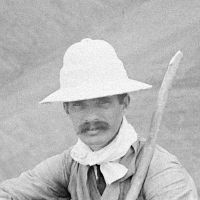
 John Smith Flett,
1911 Encyclopædia Britannica, Volume 8…
(1911)
John Smith Flett,
1911 Encyclopædia Britannica, Volume 8…
(1911)
“ Hornblende, mostly of pale green colours and somewhat fibrous habit, is very frequent in diabase; it is in most cases secondary after pyroxene, and is then known as uralite; often it forms pseudomorphs which retain the shape of the original augite. Where diabases have been crushed or sheared, hornblende readily develops at the expense of pyroxene, sometimes replacing it completely. In the later stages of alteration the amphibole becomes compact and well crystallized; the rocks consist of green hornblende and plagioclase felspar, and are then generally known as epidiorites or amphibolites. ”
