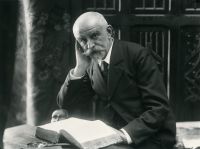
Joris-Karl Huysmans

Joris-Karl Huysmans

Summary

Portrait of Joris-Karl Huysmans Joris-Karl Huysmans Against the Grain — Chapter VII (1926)

He sought for motives to account for the change in himself; yes, he must have been forcibly drawn in the direction of the priesthood because the Church, and the Church only, has preserved the art, the lost beauty of the centuries; she has stereotyped, even in the cheap modern reproductions, the patterns of metal work, preserved the charm of chalices slim and tall as petunias, of sacred vessels of exquisite curves and contours, safeguarded, even in aluminium, in sham enamel, in coloured glass, the grace of the models of olden days.
Source: Wikisource

Portrait of Joris-Karl Huysmans Joris-Karl Huysmans Against the Grain — Chapter VII (1926)

There was the fact, odd as it might seem: he was less confident at the present moment than he had been in his boyhood, in the days when the Jesuits exercised direct supervision over his training, when their teaching had to be received, when he was entirely in their hands, was theirs, body and soul, without family ties, without any outside influences of any kind to react against their ascendancy.
Source: Wikisource

Portrait of Joris-Karl Huysmans Joris-Karl Huysmans Against the Grain — Chapter VII (1926)

At this point, Des Esseintes recovered footing. Doubtless he was content to accept this admission of social rottenness, but his mind revolted against the vague remedy offered, the hope of another life. Schopenhauer was more exact; his doctrine and the Church's started from a common point of view; he, too, took his stand on the wickedness and baseness of the world; he, too, cried out, with the Imitation of Our Lord, in bitterness of spirit: "Verily it is a pitiful thing to be alive on the earth!" He, too, preached the nullity of existence, the advantages of solitude
Source: Wikisource

Get perspective with Kwize: daily news enlightened by great literature