Summary

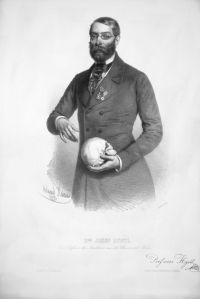
Portrait of Josef Hyrtl Josef Hyrtl Natural History Review: a quarterly journal of biological science (1861)

When, in man, there are two, three, four, or even (as sometimes) five renal arteries, you may inject one, and yet none of the others will be filled, every one of these arteries having a distinct province of its own. It is the same case in other Mammalia, when their kidneys have more than one artery entering at different portions of their surface; for instance, when an injection of the horse's kidney is made, one can spare the injected matter, by selecting any small artery which enters the external surface of the organ (not in the hilus) .
Source: Wikisource

Portrait of Josef Hyrtl Josef Hyrtl Natural History Review: a quarterly journal of biological science (1861)

When a single coronary artery of the heart is injected, the other (say the right) remains empty, showing that there is no anastomosis between the primary, or secondary, ramifications of these two arteries, in the circular and longitudinal grooves of the surface of the heart, as all anatomists say they have observed. When the injection passes from one artery to the other, it is always through the intervention of the capillary system that the communication takes place
Source: Wikisource

Portrait of Josef Hyrtl Josef Hyrtl Natural History Review: a quarterly journal of biological science (1861)

When the right lingual artery is injected with colouring matter, only one-half of the tongue becomes coloured, the other half remaining as it is. If the assumed anastomosis really existed between the two arteries (forming an arch in the top of the tongue) the injection of the one artery would certainly fill that of the opposite side.
Source: Wikisource

Get perspective with Kwize: daily news enlightened by great literature