Summary

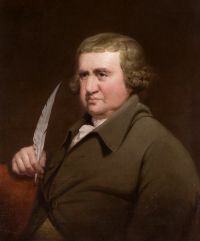
Portrait of Erasmus Darwin Erasmus Darwin Zoonomia, or, the Laws of Organic Life… (1796)

The time taken up in performing an idea is likewise much the same as that taken up in performing a muscular motion. A musician can press the keys of an harpsichord with his fingers in the order of a tune he has been accustomed to play, in as little time as he can run over those notes in his mind. So we many times in an hour cover our eye-balls with our eye-lids without perceiving that we are in the dark; hence the perception or idea of light is not changed for that of darkness in so small a time as the twinkling of an eye
Source: Wikisource

Portrait of Erasmus Darwin Erasmus Darwin Zoonomia, or, the Laws of Organic Life… (1796)

During the time of sleep, or in delirium, the ideas of imagination are mistaken for the perceptions of external objects; whence it appears, that these ideas of imagination, are no other than a reiteration of those motions of the organs of sense, which were originally excited by the stimulus of external objects: and in our waking hours the simple ideas, that we call up by recollection or by imagination, as the colour of red, or the smell of a rose, are exact resemblances of the same simple ideas from perception
Source: Wikisource

Portrait of Erasmus Darwin Erasmus Darwin Zoonomia, or, the Laws of Organic Life… (1796)

Now if the change or motion of the retina was a mechanical impression, or a chemical tinge of coloured light, the perception would every minute become stronger and stronger,—whereas in this experiment it becomes every instant weaker and weaker. The same circumstance obtains in the continued application of sound, or of sapid bodies, or of odorous ones, or of tangible ones, to their adapted organs of sense.
Source: Wikisource

Get perspective with Kwize: daily news enlightened by great literature