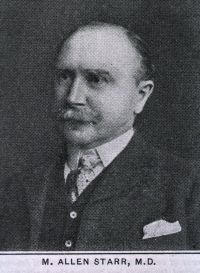
Moses Allen Starr

Moses Allen Starr

Summary

Portrait of Moses Allen Starr Moses Allen Starr Popular Science Monthly (1884)

The dog is not blind, but he has lost the power of recognizing objects formerly recognized by sight. He has been deprived, by the operation, of his sight-memory pictures, or sight-imaging power. He has been put back, as far as one sense is concerned, into the condition in which he was when born—that is, destitute of knowledge acquired by sight-perception. He acts just like a puppy
Source: Wikisource

Portrait of Moses Allen Starr Moses Allen Starr Popular Science Monthly (1884)

Thus the two independent lines of evidence unite in indicating that each region of the brain has its own work to do, its own memories to preserve.
While the anatomical evidence in favor of the localization of memories is as strong in the case of man as it is in that of the dog or ape, the physiological evidence is wanting. Physiologists lament that they can not experiment upon man, and psychologists are slow to admit that these experiments throw any light upon man's mind and its action. Just here, however, the study of disease comes in to help out our knowledge.
Source: Wikisource

Portrait of Moses Allen Starr Moses Allen Starr Popular Science Monthly (1884)

The physiologist cuts out a definite part and observes the result. The pathologist observes the result of Nature's experiment by watching the symptoms of his patient, and, after the patient's death, he can ascertain the position of the part diseased. Now, if the old theory be true, according to which the brain acts as a whole, and its various parts do not possess distinct mental functions, a limited area of disease in one part may impair the mental powers but will not produce a loss of one function.
Source: Wikisource

Get perspective with Kwize: daily news enlightened by great literature