Summary

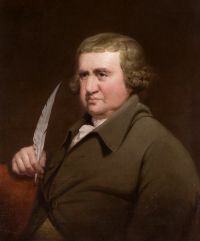
Portrait of Erasmus Darwin Erasmus Darwin Zoonomia, or, the Laws of Organic Life… (1796)

In respect to freewill, it is certain, that we cannot will to think of a new train of ideas, without previously thinking of the first link of it; as I cannot will to think of a black swan, without previously thinking of a black swan. But if I now think of a tail, I can voluntarily recollect all animals, which have tails; my will is so far free, that I can pursue the ideas linked to this idea of tail, as far as my knowledge of the subject extends; but to will without motive is to will without desire or aversion; which is as absurd as to feel without pleasure or pain
Source: Wikisource

Portrait of Erasmus Darwin Erasmus Darwin Zoonomia, or, the Laws of Organic Life… (1796)

When the progressive motions of external bodies make a part of our present catenation of ideas, we attend to the lapse of time; which appears the longer, the more frequently we thus attend to it; as when we expect something at a certain hour, which much interests us, whether it be an agreeable or disagreeable event; or when we count the passing seconds on a stop-watch.
When an idea of our own person, or a reflex idea of our pleasures and pains, desires and aversions, makes a part of this catenation, it is termed consciousness
Source: Wikisource

Portrait of Erasmus Darwin Erasmus Darwin Zoonomia, or, the Laws of Organic Life… (1796)

For we can create nothing new, we can only combine or separate the ideas, which we have already received by our perceptions: thus if I wish to represent a monster, I call to my mind the ideas of every thing disagreeable and horrible, and combine the nastiness and gluttony of a hog, the stupidity and obstinacy of an ass, with the fur and awkwardness of a bear, and call the new combination Caliban. Yet such a monster may exist in nature, as all his attributes are parts of nature.
Source: Wikisource

Get perspective with Kwize: daily news enlightened by great literature