Summary

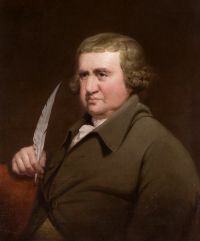
Portrait of Erasmus Darwin Erasmus Darwin Zoonomia, or, the Laws of Organic Life… (1796)

Another previous prepossession of the mind, which may have rendered the manner of our acquiring the knowledge of figure less intelligible, may have arisen from the common opinion of the perceiving faculty residing in the head; whereas our daily experience shews, that our perception (which consists of an idea, and of the pleasure or pain it occasions) exists principally in the organ of sense, which is stimulated into action; as every one, who burns his finger in the candle, must be bold to deny.
Source: Wikisource

Portrait of Erasmus Darwin Erasmus Darwin Zoonomia, or, the Laws of Organic Life… (1796)

Some, who have espoused the doctrine of the immateriality of ideas, have seriously doubted the existence of a material world, with which only our senses acquaint us; and yet have assented to the existence of spirit, with which our senses cannot acquaint us; and have finally allowed, that all our knowledge is derived through the medium of our senses! They forget, that if the spirit of animation had no properties in common with matter, it could neither affect nor be affected by the material body.
Source: Wikisource

Portrait of Erasmus Darwin Erasmus Darwin Zoonomia, or, the Laws of Organic Life… (1796)

When a person revolves with his eyes closed, till he becomes vertiginous, and then stands still without opening them, he seems for a while to go forward in the same direction. This hallucination of his ideas cannot be owing to ocular spectra, because, as Dr. Wells observes, no such can have been formed; but it must arise from a similar continuance or repetition of ideas belonging to the sense of touch, instead of to the sense of vision; and should therefore be called a tangible, not a visual, vertigo.
Source: Wikisource

Get perspective with Kwize: daily news enlightened by great literature